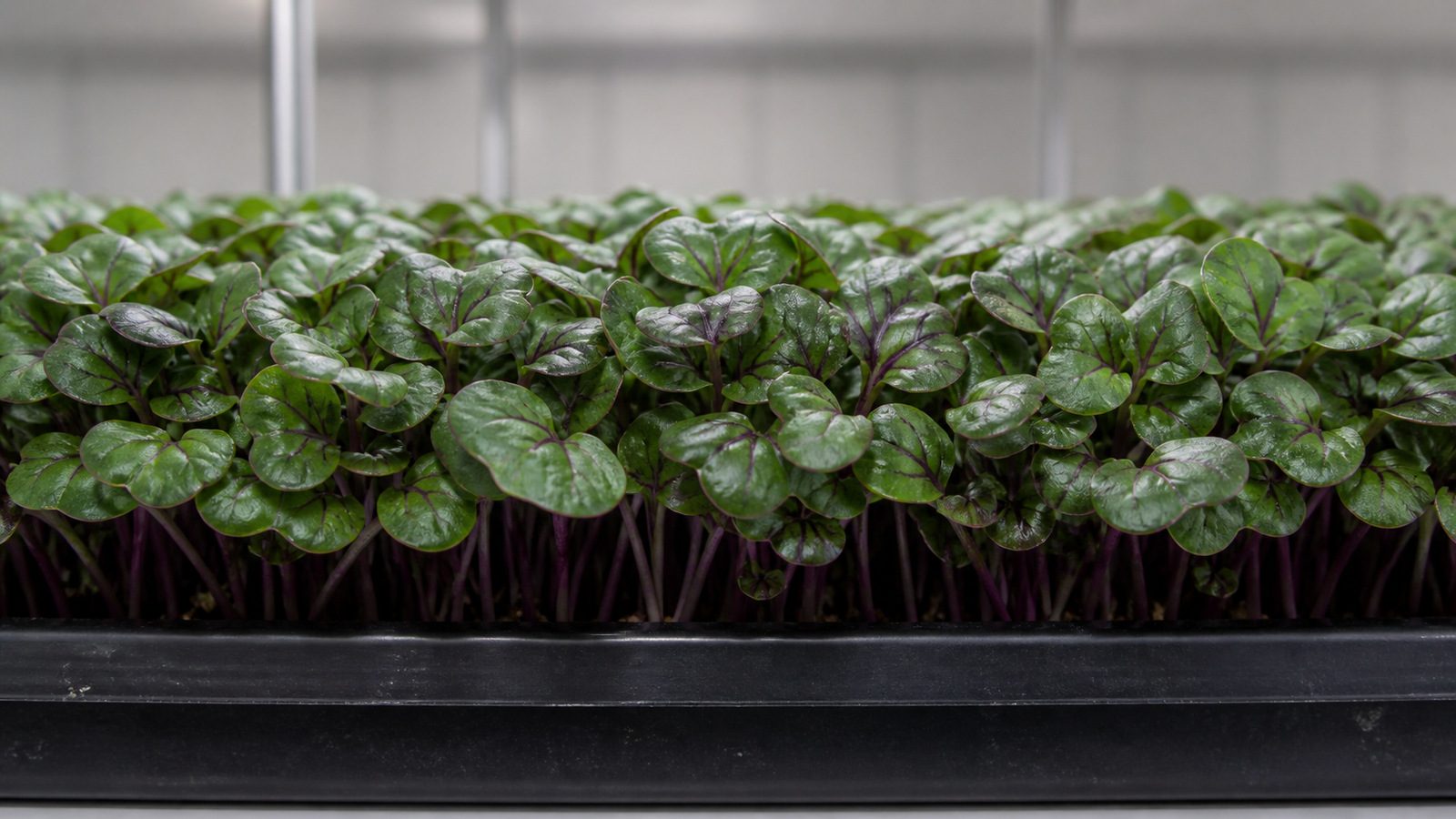
At a glance
Quick predictable germination and a broad unmistakable cotyledon that makes the harvest cue obvious, so the timing is forgiving; what catches people is density and moisture rather than anything about the crop's schedule.
- Botanical name
- Brassica oleracea var. capitata
- Also sold as
- Cabbage, Red, Red Acre, Mammoth Red Rock
- Family
- brassica
- Difficulty
- Beginner
- Days to harvest
- 8 to 15 days
- Harvest window
- No published figure
- Seed per 1020 tray
- 10.5 g
- Soak
- None
- Blackout
- 3 to 6 days
- Germination temperature
- 65 to 75 °F
- Yield per 1020 tray
- 8.5 oz
- Regrows after cutting
- No published figure
- Mold risk
- Medium
- Hull shedding
- some
- Shelf life
- 5 to 10 days
- Eaten as
- raw
- Seed cost per tray
- $1.27
10.5 g at $54.66/lb, Johnny's organic red cabbage microgreen seed, listed 2026-08-08. Seed only, excludes medium, tray, labor, light and loss.
Any field name above ranks every variety by it. No published figure means we researched it and nobody has established one, which is different from not yet researched. Every figure here is sourced at the bottom of the page. Compare every variety side by side.
Cabbage is the crop where this directory can finally do something no single-crop page can. Four mild brassicas compete for exactly the same tray slot, and all four were measured in the same 2017 greenhouse trial, by the same method, at the same first-true-leaf harvest stage. Broccoli returned 11.5 oz, kale 11, mustard 9.5, and cabbage 8.5.
So cabbage is last of the four, from more seed than kale or mustard and a day slower than broccoli. That is the honest starting point, and the rest of this page is about the one thing it offers that none of them can: the purple veining and purple leaf margins on the red types. If your buyer wants that color, nothing else in the group will do. If they do not, broccoli is the better tray.
What growers are saying right now
Sampled from public posts and videos, 9 July to 8 August 2026. Every line links what it is quoting. How often something is repeated is not evidence that it is true, so every line also says what the sources actually establish.
What are you putting in your mixes?
Circulating One of the most-discussed threads in r/microgreens this window at 27 comments
The right question for this crop, because a mix is where cabbage actually earns its place. Sold alone it loses to broccoli on the one trial that measured them together, 8.5 oz against 11.5 from the same tray at less seed. In a mix the calculation changes, because what it contributes is not weight but purple veining and purple margins that no broccoli produces at any seed rate. Is it worth growing
Stop the garnish
Circulating A push against treating microgreens as decoration, 6,861 views, asking how people actually eat them
Cabbage is one of the crops that argument genuinely fits. It is sold for salads and sandwiches rather than as a finish, which makes it a volume green, and that is precisely why its lower yield matters more here than it would on something sold by the pinch. A garnish crop can afford to be light. A salad crop cannot.
Red cabbage, but make it micro
Circulating A small grower post at 827 views, and very nearly the only actual cabbage MICROGREEN content in the window
Everything else ranking on the words is the mature vegetable: seed to harvest on full red cabbages at 16,404 views, a garden update, Turkish pickled red cabbage. Worth knowing before you search for growing advice, because a mature cabbage timeline has nothing whatever to do with a tray, and the word belongs to the vegetable.
We were just trying to sell microgreens
Circulating The top-scoring thread in the sub, 40 points, where a grower describes moving from selling cut produce to installing systems in restaurants: "we charge a one time setup fee to set the system up. Then we charge them the usual price per tray, yes lower than cut produce for sure, plus transportation"
Relevant here because per-TRAY economics are what decide whether a crop stays in a rotation, and cabbage is the crop most exposed to that arithmetic. Eight and a half ounces where broccoli gives 11.5, from the same bench space and a day longer. Sell by the ounce and that is a modest gap. Sell by the tray and it is most of the margin. The four-brassica comparison
All of those microgreens in one scoop
Circulating The powder promotions again, at 138,609 and 96,663 views, still the widest-reach microgreen content of the month
There is no cabbage microgreen record in USDA FoodData Central. What exists is a peer-reviewed study that included red cabbage among six species and reached a carefully limited conclusion: microgreens can be concentrated sources of some, not all vitamins, minerals and bioactive compounds, varying by species and by maturity. "Some, not all" is the actual finding, and it is close to the opposite of a scoop that replaces vegetables. What is actually established
What it is, and how to tell you grew it right
Cabbage microgreens are seedlings of Brassica oleracea var. capitata, cut above the medium at cotyledon or first true leaf. Red and green types are both sold, and they are cultivars of one crop rather than different species.
A correct green cabbage tray is two broad, rounded mid-green cotyledons on short, crisp white stems, in a notably even stand. Evenness is the thing to judge it by: this crop germinates predictably and a patchy cabbage tray is telling you about your sowing rather than about the seed.
Red cabbage looks like a different crop, and that is the point. Johnny's describes dark green glossy leaves with purple veins and purple leaf margins, and a documented commercial run of Red Acre shows purple to magenta stems. That coloring is the entire commercial argument for growing cabbage over broccoli, so it is worth choosing the seed for it deliberately rather than accepting whatever "cabbage" arrives.
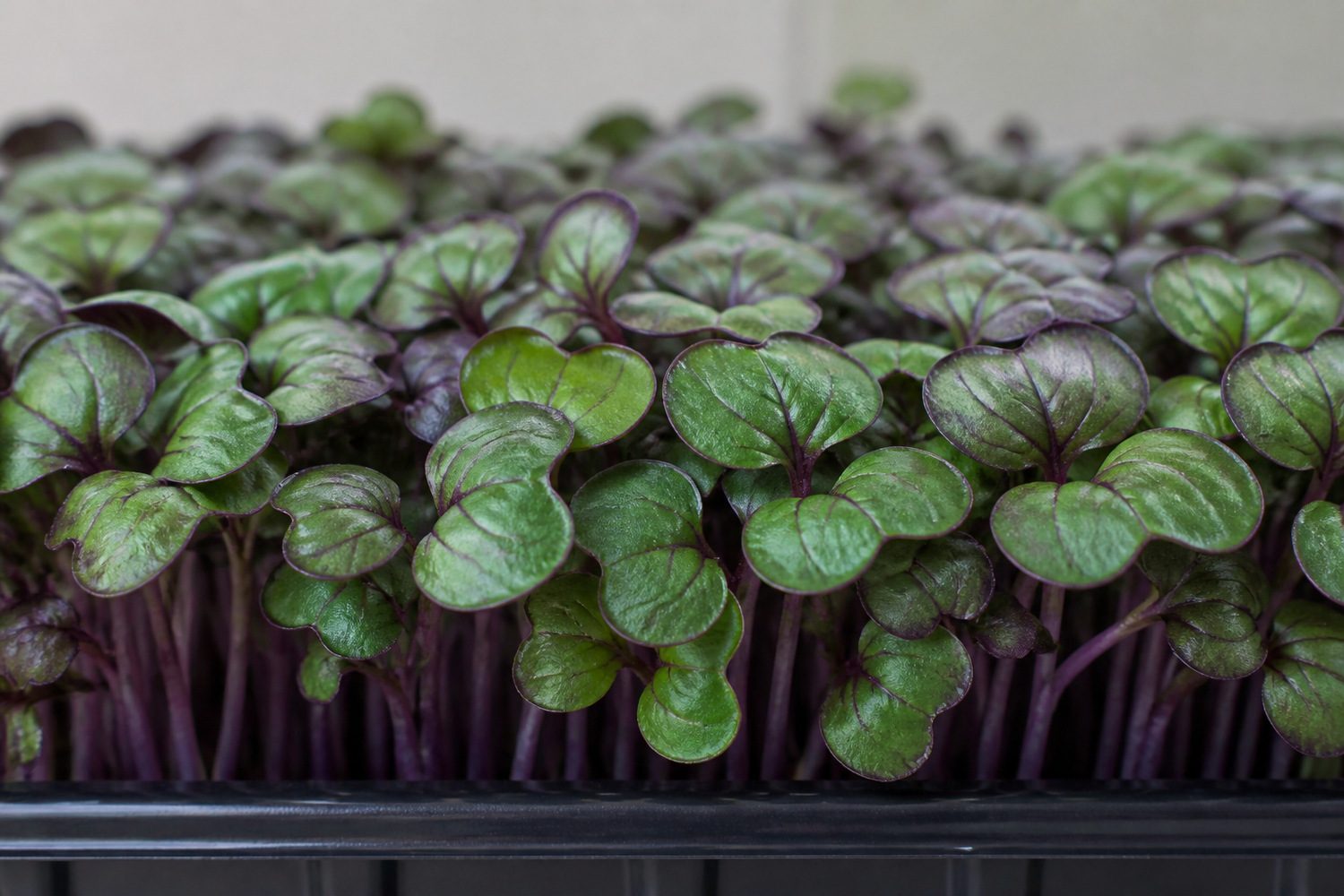
It is confused with broccoli and the other mild brassicas, and at cotyledon stage a green cabbage tray genuinely cannot be told apart from them. Do not try to identify one from stem color. On the red types the purple veining and margin settle it immediately, which is a tell that belongs to those cultivars rather than to cabbage as a crop.
What it tastes like, and what to do with it
Mild and crisp, with a small peppery edge. Johnny's describes its red cabbage as mild brassica with a touch of heat, which is accurate and usefully unglamorous. It is gentler than the mature head, and it becomes more recognizably cabbage as the true leaves advance.
Use it where a dish wants mild brassica flavor, crispness and a small leaf that adds visible volume: mixed salads, sandwich fillings, and as a finishing layer where the purple-green contrast does work. Its natural home is a mix, and that is not a consolation prize. In a blended pack the color is the product and the mild flavor keeps it from fighting anything else in the bag.
It is the wrong choice when the plate wants a sharp peppery bite, which is mustard or radish, and it is not a cooked leafy green. The people who will not like it are the people who dislike brassica flavor at all, because mild is not the same as neutral, and nobody has run a consumer panel to tell you how large that group is.
Growing it: only what differs from the standard method
Everything general about trays, medium, light and watering is on the standard tray method for growing microgreens. Cabbage barely departs from it, which is most of why it is a beginner crop.
Ten and a half grams per 1020, not twenty to thirty. Johnny's trial measured 10.5 g, about three flats to the ounce of seed, and the product page repeats it. A commercial Red Acre system runs 17 to 20 g on the same tray, and that grower's own note is the useful part: 21 g produced late bloomers, so they settled back to 17. That is a grower discovering the ceiling by hitting it, which is worth more than any of the round numbers this page used to publish.
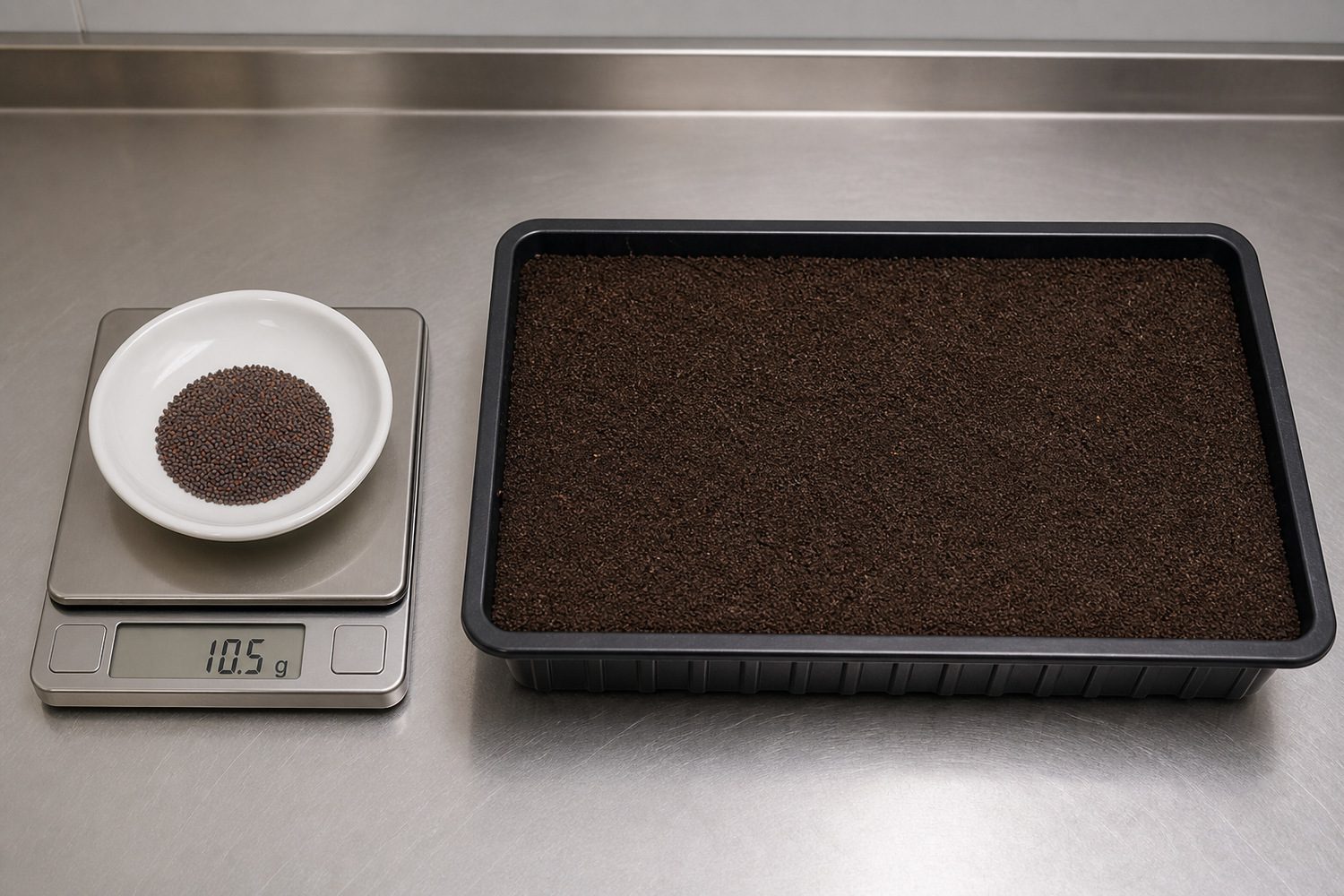
No soak. One crop table lists red cabbage explicitly as no pre-soak, and Johnny's gives no soaking instruction. Nothing establishes a beneficial duration or water temperature for cabbage, so sow it dry.
Broadcast at an eighth to a quarter inch apart, press firmly, cover lightly or dome. Level the medium properly first. The seed is small and numerous, so a high or low spot in the surface turns into uneven water and uneven emergence, and that is the failure that looks like a bad lot.
Warm to germinate, then cool. Johnny's brassica program: 75°F at the medium until germination, then 60°F, with 65 to 75°F favorable ambient and a warning that above 75°F germination can be inhibited and disease pressure rises.
If you weight it, three days is what one commercial system uses. That run used about 15 lb under an inverted tray for three days, then roughly three more under an unweighted dome, taking the weight off when roots were reaching down and the canopy was even. Its stated purpose is even germination and root contact first, then a little extra stem length for a cleaner cut. Virginia Tech's general instruction still applies underneath it: uncover once the majority have germinated.
Light is the one place cabbage has real published numbers, and they disagree. Virginia Tech cites cabbage research at 14 to 16 hours a day at 70 to 90 µmol, and separate cabbage and radish work at 8 hours at 200 µmol. Those are study conditions rather than a recommendation, and reading them as "cabbage wants more light than a brassica" would be inventing a comparison neither study made.
A cabbage tray, day by day
- 1
Day 0, sow dry
10.5 g broadcast at an eighth to a quarter inch apart on levelled, pre-moistened medium, pressed firmly, covered lightly or domed. No soak. Medium at about 75°F.
- 2
Days 1 to 3, weighted
About 15 lb under an inverted tray in the documented commercial run, for even germination and root-to-medium contact. Off when roots reach down and the canopy is even.
- 3
Days 3 to 6, dome
Roughly three more days unweighted, which that system uses to add a little stem length for a cleaner cut. Uncover once the majority have germinated.
- 4
After uncovering
Medium toward 60°F, ambient 65 to 75°F. Bottom water or mist rather than a forceful top stream, so medium is not splashed onto the stems.
- 5
Days 8 to 15, cut
Watch for the first true leaves showing above the cotyledons. Johnny's trial averaged 13.5 days; a commercial Red Acre system usually runs 8 to 12 and cut at 13 for extra height.
What goes wrong with cabbage specifically
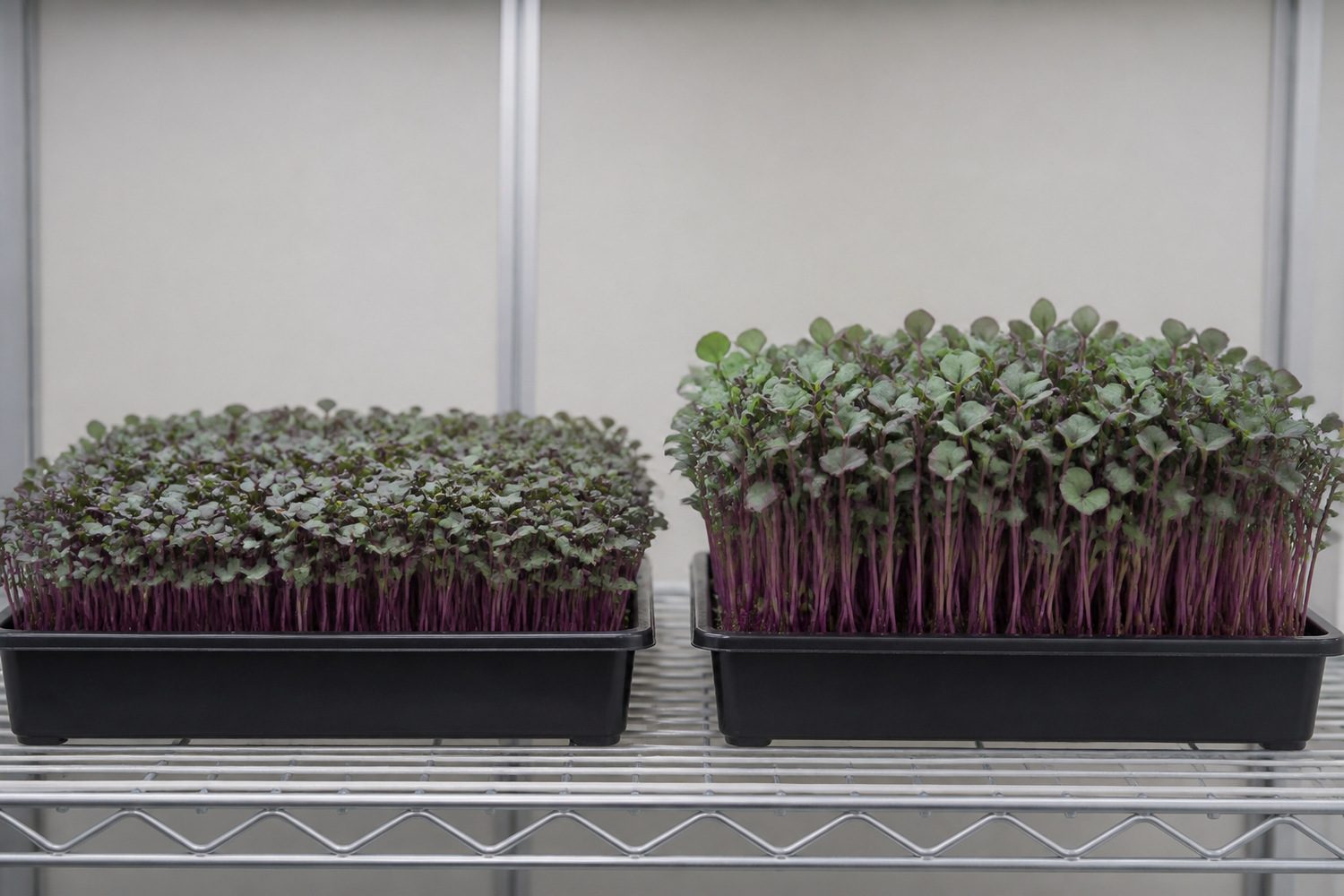
Overseeding is the mistake, and cabbage has an unusually clear account of it. Most crops here give you a rate and leave you guessing about the ceiling. On cabbage a grower ran 21 g on a 10 by 20, got late bloomers, and dropped to 17. Dense clumps cut airflow and produce an uneven canopy, and the consequence is a lower-quality harvest with more moisture sitting in it.
Patchy or late emergence. Bare spots beside clumps, or seedlings lagging. The cause is usually uneven medium, uneven distribution, or simply too much seed. Recoverable only if the stand is still clean, and do not reseed into a food tray.
Damping-off in the wet, dense phase. Seedlings thinning, collapsing, or rotting at or below the medium line, with Pythium damage sometimes showing at the root tips first. Johnny's names the conditions directly: densely planted microgreens with poor air circulation and saturated medium. A visibly collapsing tray is not saleable.
Root hairs mistaken for mold, and on this crop it is especially common. Cabbage produces fine white fuzz at every germinating seed, and red cabbage is called out specifically as prone to it. The distinction is behavioral rather than visual: root hair appears broadly, on every seed, at the roots, and smells fresh. Mold starts in a spot, spreads over days, can bridge above the medium or onto the greens, and smells musty. Slime and colored spots are the warning. If you have uniform fuzz everywhere on day three, you almost certainly have a working tray.
Uniform everywhere, or spreading from a spot?
Hover or tap a card to highlight it.
Count the seeds it is on
Root hair shows at essentially EVERY germinating seed at once. Mold starts on one patch and is still one patch an hour later.
Watch it over a day
Root hair does not advance. Mold spreads, and by the next day it covers more ground than it did.
See where it sits
Root hair stays at the roots and the medium line. Growth bridging above the medium or onto the greens is not root hair.
Smell it
Fresh and airy is right. Musty or pungent is not, and smell is the tell people ignore longest.
Look for the extras
Slime and colored spots belong to mold and never to root hair. Red cabbage in particular throws a lot of harmless fuzz, so judge on spread and smell rather than on quantity.
Past the cut, the canopy separates. True leaves push above the cotyledons and the plants start leaning apart. It is still harvestable if clean, but it has stopped being the uniform cotyledon-led product the trial measured. What nobody has established for cabbage is what that costs in toughness, flavor or saleable weight, so this page does not put a number on it.
A bad lot looks like low or staggered emergence despite even medium and water. Johnny's publishes about 117,000 seeds per pound for its product and no germination percentage or lot variance, so there is nothing to compare a suspect lot against. Run a counted germination test and a single tray before committing a new lot.
Nutrition, and what is actually established
There is no cabbage microgreen record in USDA FoodData Central. Mature cabbage entries are a different food and are not a substitute.
There is a peer-reviewed study worth knowing about, and its value is its restraint. It evaluated metabolites and minerals across six microgreen species, red cabbage among them, comparing microgreen material against mature counterparts using non-targeted metabolomics and ionomics. Its conclusion is that microgreens can be concentrated sources of some, but not all, vitamins, minerals and bioactive compounds, and that composition varies by species and by maturity.
That is a genuinely useful sentence and it is the one the category never quotes. It does not say microgreens beat mature vegetables; it says some compounds go up, others do not, and which is which depends on the crop and the stage. Any claim of a fixed multiple against mature cabbage, a superfood label, or a health outcome, needs an analyte, a cultivar, a harvest stage, units and an assay behind it, and none of those exist for this crop.
Which seed to buy
Buy a red type, deliberately, and by cultivar name. This is the one crop in the mild brassica group where the seed choice is the commercial decision, because purple veining is what you are selling.
Johnny's Cabbage, Red is the one with trial numbers: 10.5 g per 1020, 8.5 oz, 13.5 days to first true leaf, dark green glossy leaves with purple veins and margins. Its page does not name a cultivar, which is worth noticing.
Red Acre is a named red cabbage cultivar. In one grower's system it runs 8 to 12 days and takes the longer dark treatment described above. Mammoth Red Rock is another named cultivar, and in that same grower's hands it was more vigorous, needing three to four weighted days plus about one blackout day rather than Red Acre's longer run. No controlled trial compares them for yield or tenderness, so treat that as one system's observation rather than a ranking.
Specify untreated seed intended for edible microgreen or sprout use, with the cultivar named and lot information where available. Refuse treated field seed: SDSU Extension is explicit that dyes, fungicides or insecticides on seed may be present in the young shoots that get eaten. Organic is a useful additional criterion and does not replace confirming the seed is untreated.
Red cabbage microgreen seed on Amazon is the convenient route for a home grower. If the purple is the reason you are growing it, buy where the cultivar is named.
Is it worth growing?
Yes, for color, and honestly not for much else.
The four mild brassicas were measured in one trial, and cabbage came last: 8.5 oz against broccoli's 11.5, kale's 11 and mustard's 9.5. It uses more seed than kale or mustard to do it and takes a day longer than broccoli. On economics there is no argument to make, and pretending otherwise would be the easy thing to write.
What it has is the purple, and that is a real commercial asset rather than a consolation. Dark green glossy cotyledons with purple veining and purple margins are not something broccoli, kale or mustard can produce at any seed rate or any harvest stage. In a mixed pack that contrast is what makes the bag look like a product rather than a handful of green. If a customer is buying on appearance, and in mixes many are, cabbage is worth its slot at a lower yield.
It suits a beginner who wants a quick, visually obvious brassica; a home grower who wants mild raw greens for salads and sandwiches; and a market grower selling mixes rather than single-crop weight. It suits nobody chasing yield per tray, and nobody selling to a buyer who wants heat.
One caution that applies more here than elsewhere. Johnny's 8.5 oz is a starting benchmark from one greenhouse in one autumn, and its own caveat travels with it: yields vary with procedure, technique, system, conditions, harvest stage and seed lot. Weigh your own trays before you build a price on it.
A note on the numbers above
Hover or tap a row to highlight it.
| Figure | Value | Source | What kind of number it is |
|---|---|---|---|
| Seed per 1020 | 10.5 g | Johnny's 2017 trial | Measured, at first true leaf |
| Seed per 1020 | 10.5 g | Johnny's product page | Repeated independently of the trial |
| Seed per 1020 | 17 to 20 g | On The Grow, Red Acre | Commercial practice, on coco coir |
| Seed per 1020 | 21 g | Same grower, rejected | Produced late bloomers; they dropped to 17 |
| Seed per 1020 | 20 to 30 g | This site, before research | Provisional. Wrong by 1.9x to 2.9x |
| Yield per 1020 | 8.5 oz | Johnny's 2017 trial | Measured, at first true leaf, three-plus seedings |
| Yield per 1020 | 6 to 10 oz | This site, before research | Provisional. Bracketed the measured figure |
| Days to harvest | 13.5 average | Johnny's 2017 trial | Measured, to first true leaf |
| Days to harvest | 10 to 15 | Johnny's product page | Published range |
| Days to harvest | 8 to 12 | On The Grow, Red Acre | That system's usual range; cut at 13 for height |
| Blackout | 3 days at ~15 lb, then ~3 domed | On The Grow | One commercial system, not a measured requirement |
| Germination temperature | 75°F then 60°F | Johnny's | Crop guidance, not a trial |
| Light | 14 to 16 h at 70 to 90 µmol | Virginia Tech, citing cabbage research | Study conditions, not a recommendation |
| Light | 8 h at 200 µmol | Separate cabbage and radish work | Different study, different conditions |
| Seeds per pound | About 117,000 | Johnny's | A product specification, with no germination stated |
| Shelf life | 5 to 10 days | Johnny's | No temperature or package stated |
| Harvest window | No published figure | Nobody | Called forgiving, with no day count attached |
| Regrows | No published figure | Nobody | Nothing measures a second cut OR rules one out |
| Seed cost per 1020 | $1.27 | Calculated, Johnny's price | 10.5 g at $54.66/lb, listed 2026-08-08 |
Regrows says no published figure here, and every other entry on this site says no. That difference is deliberate. The others have a source stating there is no useful second cut. For cabbage, nothing opened either measures a second harvest or rules one out. Treating it as a one-cut crop is a sensible production decision, and recording a production decision as a research finding is the exact error this directory exists to correct. If you cut one and it comes back, that is new information rather than a contradiction.
The seeding correction is the familiar one and the commercial rate is the familiar counterpoint. Twenty to thirty grams became a measured 10.5. A working commercial system runs 17 to 20 on the same tray, which is nearly double the trial, and the same grower found the ceiling at 21. Both are true: the trial rate is what was measured at first true leaf, and 17 to 20 is what one system does in coco coir with its own airflow. The old figure sat above both.
Hover or tap a row to highlight it.
| Crop | Seed per 1020 | Yield | Days | Cost per tray | Oz per $1 |
|---|---|---|---|---|---|
| Broccoli | 13 g | 11.5 oz | 12.5 | $0.79 | 14.5 |
| Kale, Red Russian | 10 g | 11 oz | 13.5 | $1.07 | 10.3 |
| Mustard, Garnet Giant | 8 g | 9.5 oz | 12.5 | $1.56 | 6.1 |
| Cabbage, Red | 10.5 g | 8.5 oz | 13.5 | $1.27 | 6.7 |
This is the cleanest comparison on the whole site, and it is worth explaining why. Almost every number in this category comes from a different grower, a different medium, a different harvest stage, so comparing two of them is usually meaningless. These four came from one greenhouse, one method, one autumn, and one harvest standard. Whatever that system's quirks were, they applied equally to all four, so the ranking between them survives even if the absolute figures do not transfer to your bench.
Read down the yield column and the decision makes itself: broccoli returns 35 percent more than cabbage from the same tray, at 62 percent of the seed cost, one day sooner. Cabbage's answer is not a number. It is the purple.
Hover or tap a row to highlight it.
| Crop | Seed per 1020 | Yield | Days | Cost per tray | Oz per $1 | Oz per tray-day |
|---|---|---|---|---|---|---|
| Broccoli raab | 12 to 37 g | 5.29 to 8.82 oz | 7 to 12 | $0.49 | 14.4 | 0.74 |
| Kohlrabi, Purple Vienna | 9.5 g | 11 oz | 10 to 16 | $0.89 | 12.4 | 0.69 |
| Cabbage, Red | 10.5 g | 8.5 oz | 13.5 | $1.27 | 6.7 | 0.63 |
| Tatsoi | 7.5 g | 8.5 oz | 13.5 | $0.93 | 9.1 | 0.63 |
| Garden cress | 10.5 g | 8.0 oz | 8 to 15 | $0.96 | 8.3 | 0.62 |
All 61 crops, sortable, on the microgreen comparison.
Prices move, so the dollar columns are dated rather than permanent. The rankings are the durable part, and the two performance columns still disagree for the reason set out on cilantro: sunflower wins on bench turnover and mizuna wins on seed cost, and which matters depends on whether your constraint is space or money. Corrected 2026-08-09: arugula held the seed-cost column until mizuna came in at about 25 oz per dollar.
Terms on this page
Tap a term to see what it means.
Cotyledon. The seed leaf. Cabbage's are broad and rounded, and on the red types they carry purple veining and purple margins.
Sources
- Johnny's Selected Seeds, cabbage red organic microgreen seed - 10.5 g per 1020, about 3 flats per ounce, 10 to 15 days, dark green glossy leaves with purple veins and margins, mild brassica flavor with a touch of heat, sowing at an eighth to a quarter inch with firm contact, 75°F then 60°F with 65 to 75°F favorable and the above-75°F warning, densely planted trays named as the damping-off risk, about 117,000 seeds per pound, 5 to 10 days storage, and the $54.66/lb price behind the cost calculation, listed 2026-08-08.
- Johnny's microgreens yield trial results (PDF) - Cabbage Red at 10.5 g and 8.5 oz at 13.5 days, alongside broccoli 13 g and 11.5 oz, kale Red Russian 10 g and 11 oz, and mustard Garnet Giant 8 g and 9.5 oz, all at first true leaf in the same trial.
- Johnny's microgreens yield trial, method and discussion - the 2017 greenhouse method from mid-August to late October, at least three seedings per variety, and the warning that yields vary with procedure, technique, system, conditions, harvest stage and seed lot.
- On The Grow, how to grow red cabbage microgreens - the Red Acre run on coco coir at 17 to 20 g, 21 g producing late bloomers, about 15 lb for 3 days then roughly 3 domed days, 8 to 12 days usual with a day-13 cut for height, 16 to 17 hours of light, bottom watering from a half cup twice daily rising to about 2 cups a day, purple to magenta stems, and Mammoth Red Rock being more vigorous with a shorter dark period.
- True Leaf Market, Red Acre cabbage microgreens seeds - Red Acre sold as a named red cabbage cultivar for microgreen use.
- Virginia Tech Extension SPES-756 (PDF) - cabbage microgreens as B. oleracea var. capitata, density set by species and system, uncovering once a majority have germinated at typically two to five days, and the cited cabbage light research at 14 to 16 hours and 70 to 90 µmol alongside separate work at 8 hours and 200 µmol.
- SDSU Extension, growing microgreens at home - salad, sandwich and garnish use, rinsing and drying before refrigerated storage for about a week, and why dyes, fungicides or insecticides on seed are unacceptable on a crop eaten as young shoots.
- UC IPM, damping-off - Pythium and Rhizoctonia solani, the conditions each favors, and rot at or below the medium line with Pythium root-tip damage appearing first.
- Seedmart microgreen growing and troubleshooting guide (PDF) - red cabbage listed explicitly as no pre-soak, and the mold warning signs of slime and colored spots.
- Microgreen Shop, mold or micro-roots - root hair appearing broadly at every germinating seed and especially common on red cabbage, against mold starting in a spot, spreading over days, bridging above the medium, and smelling musty.
- Comprehensive evaluation of metabolites and minerals in 6 microgreen species and the influence of maturity - red cabbage among six species compared against mature counterparts by non-targeted metabolomics and ionomics, concluding microgreens can be concentrated sources of some but not all vitamins, minerals and bioactive compounds, varying by species and maturity.
- USDA FoodData Central - searched 2026-08-08, no cabbage microgreen record located.
Keep reading
The variety directory
Arugula microgreens
Arugula is the seasoning green of the directory: 10 g of seed makes 10 oz in 14 days, it is genuinely peppery, and it is the one crop here with a controlled storage study behind its shelf life.
Read Arugula microgreensThe variety directory
Broccoli microgreens
Broccoli is the one crop in this directory with measured trial data behind it: 13 g per 1020 tray and 11.5 oz at first true leaf, which is a third of the seed most guides tell you to buy.
Read Broccoli microgreensThe variety directory
Collard microgreens
The one crop measured where more light did not buy more weight. Collard was the documented exception in a controlled DLI study, and it is the first entry here whose mold risk is honestly blank.
Read Collard microgreensThe variety directory
Garden cress microgreens
The crop where somebody finally measured what over-sowing costs: peak yield at 12 seeds per square centimeter, and roughly eight times the bacteria at 14. Plus 8 oz a tray at 13 days from the trade's own trial.
Read Garden cress microgreens