At a glance
- Botanical name
- Cannabis sativa
- Also sold as
- Hemp, Hemp sprouts (whole seed), Loja, Live raw viable hemp seed
- Family
- other
- Difficulty
- Test your own tray
- Days to harvest
- 8 to 10 days
- Harvest window
- Test your own tray
- Seed per 1020 tray
- Test your own tray
- Soak
- Test your own tray
- Blackout
- Test your own tray
- Germination temperature
- Test your own tray
- Yield per 1020 tray
- Test your own tray
- Regrows after cutting
- Test your own tray
- Mold risk
- Test your own tray
- Hull shedding
- Test your own tray
- Shelf life
- Test your own tray
- Eaten as
- raw
- Seed cost per tray
- Test your own tray
Any field name above ranks every variety by it. Where a field has no established number, weigh or measure your own tray for it. Every figure here is sourced at the bottom of the page. Compare every variety side by side.
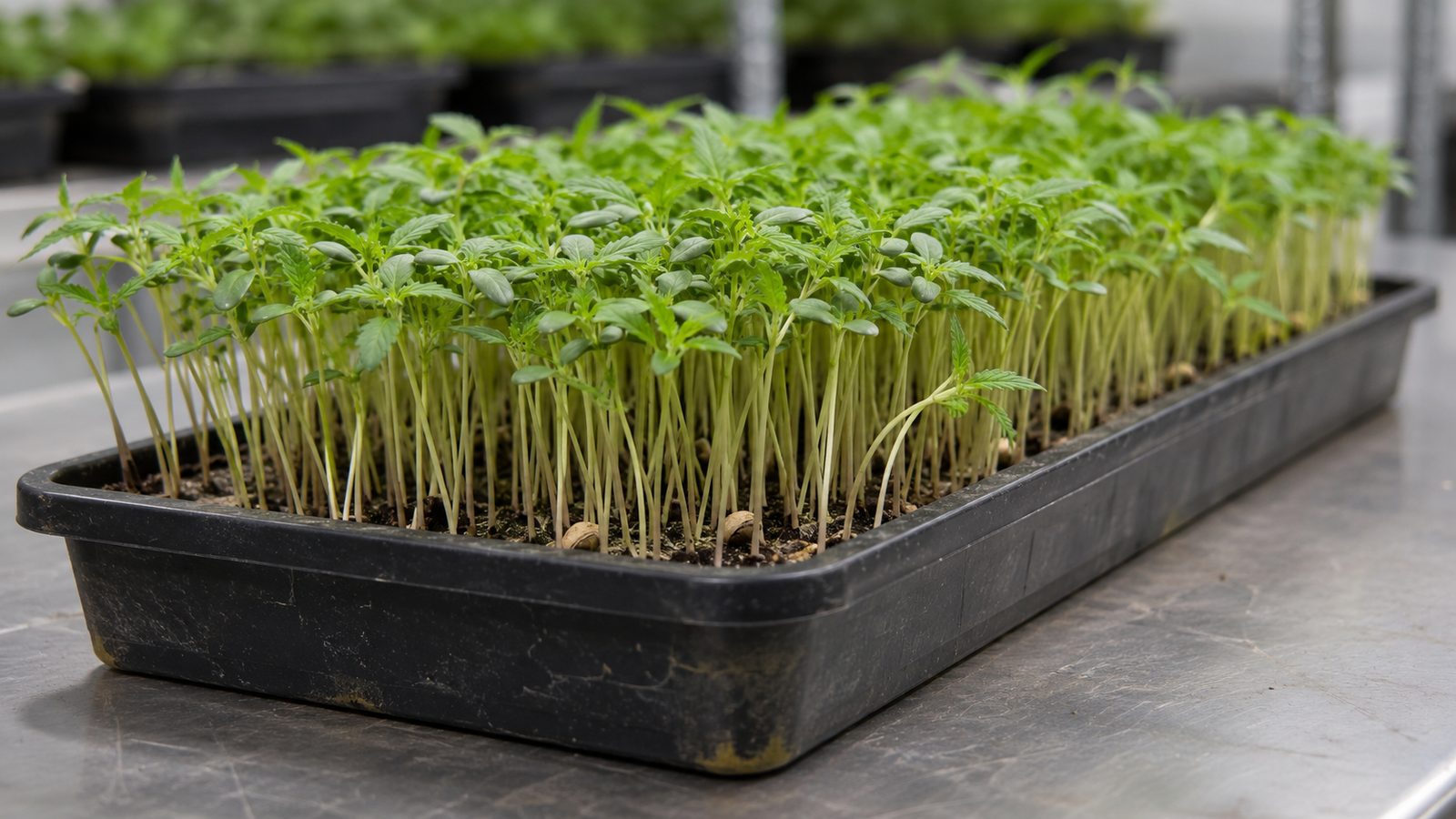
Hemp microgreens are young Cannabis sativa seedlings cut above the medium, and for a home grower the first question is a legal one, not a growing one. Sellers list whole, raw seed marketed for sprouting, but USDA requires hemp producers to be licensed or authorized under a state, tribal or USDA hemp program.
Check with your state agriculture department before you order seed. State rules can add licensing, seed-source paperwork, reporting and inspection on top of the federal ones.
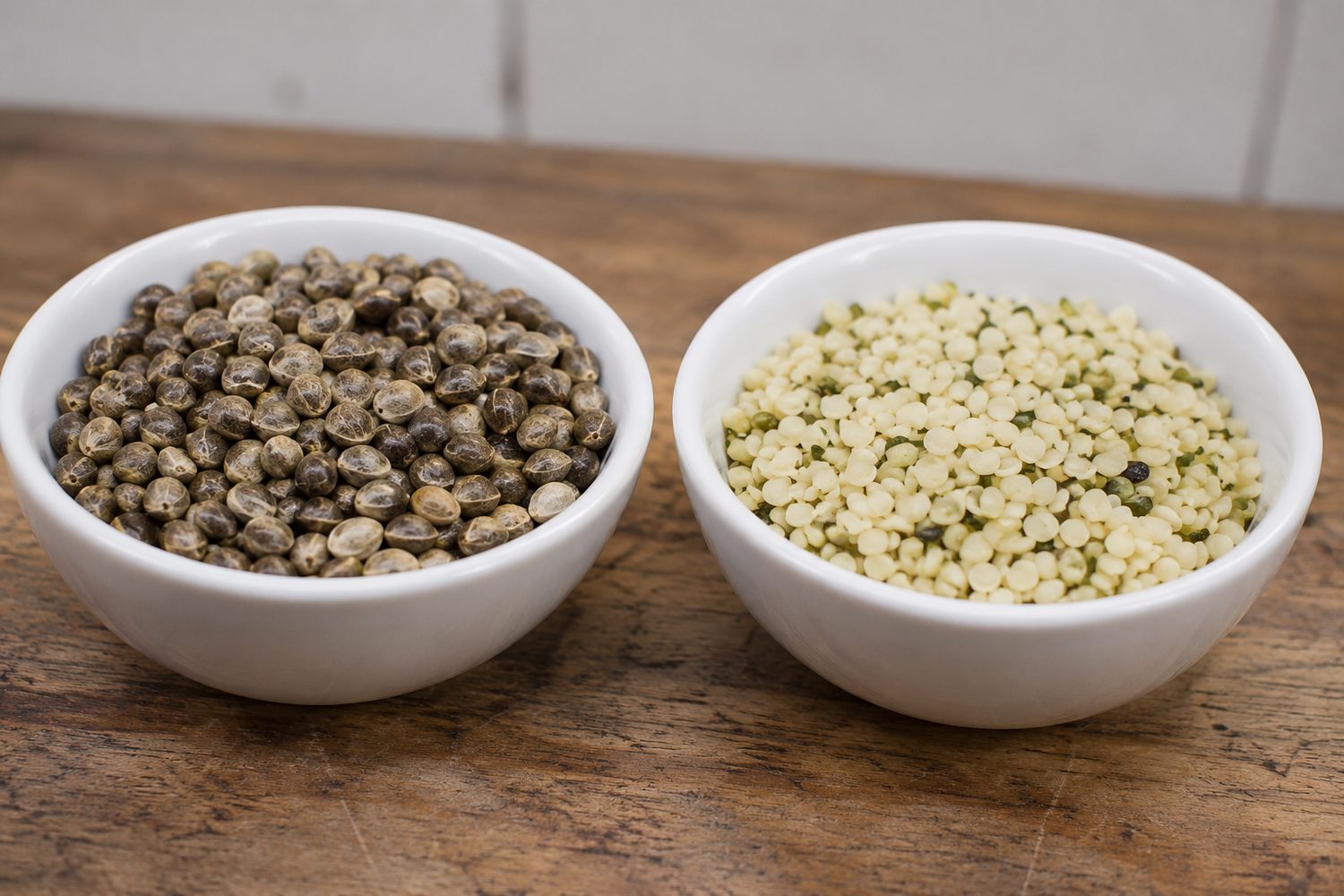
Hemp hearts are commonly sold shelled, toasted, crushed or sterilized, and those forms are not suitable for sprouting, so the seed you buy has to be sold whole, raw and viable. Plan on a small labeled test tray first to set your own sowing rate and soak. If you would rather start without the licensing question, sunflower is another large-seeded crop to try.
Can you grow it at home, and what does the law say?
Federal law treats hemp and marijuana differently by one measurement. The 2018 Farm Bill definition covers Cannabis sativa and its seeds when delta-9 THC is no more than 0.3 percent on a dry-weight basis (Congressional Research Service, Defining Hemp, read 2026-11-19). DEA states that hemp at or below that threshold is not a controlled substance and does not need DEA registration to grow or research (DEA, 2019 announcement, read 2026-11-19).
That is not the end of it. USDA's hemp page says a producer must be licensed or authorized under a state, tribal or USDA hemp program (USDA AMS, Hemp Production, read 2026-11-19). Whether a small home planting counts as production under your state's program is a question for your state agriculture department, and it is worth asking before you spend anything on seed.
State rules differ, and two published plans show how much:
Hover or tap a row to highlight it.
| State | What the plan says | Read |
|---|---|---|
| Alabama | Requires a hemp license and prior approval to acquire planting material. Seed must be untreated and uncoated, from a compliant hemp crop. Planting is reported within 5 business days. Hemp microgreens are seedlings harvested no more than 14 days after germination and no taller than 5 inches. | Alabama Hemp Plan, 2026-11-19 |
| Pennsylvania | Requires seed-source documentation, phytosanitary compliance, labeling, and a third-party statement that the variety is no more than 0.3 percent THC on a dry-weight basis. | Pennsylvania Hemp Plan, 2026-11-19 |
Other states set their own rules, and seed source, reporting, inspection, testing, imports and disposal can all differ where you live, so confirm them with your own state hemp program. This page is a summary of what the agencies publish and is not legal advice.
Even with the legal question settled, viable seed and legal permission are separate things. A seller saying seed is viable does not tell you that you may plant it.
What it is, and how to tell you grew it right
Hemp microgreens are immature hemp seedlings harvested above the medium before flowering. A hemp sprout is different: a germinated seed or very young seedling, generally harvested earlier. The family is Cannabaceae (Dimopoulos et al., 2025, read 2026-11-19).
Three timings are published, from three different kinds of source:
Hover or tap a row to highlight it.
| Who | Timing | What kind of number |
|---|---|---|
| Nordamark Loja listing | About 8 days to harvest, with about 3 days to germinate | A seed seller's listing |
| Dimopoulos et al., 2025 | A 10-day growth period | A peer-reviewed study of hemp microgreens |
| Alabama Hemp Plan | No more than 14 days after germination, no taller than 5 inches | A state legal definition |
A related study of baby-leaf hemp harvested at about 13 to 18 days from sowing, at third true leaf, which is a larger plant than a microgreen (Pannico et al., 2020). Cut earlier than that, and within any harvest-age limit your state sets. You are looking for an even stand of upright seedlings with the medium mostly covered.
What it tastes like, and what to do with it
Nordamark describes hemp microgreens as mild and nutty and suggests salads, smoothies, sandwiches and garnish (Nordamark). Grower reports describe the flavor as nutty, peppery or bitter, varying with seed lot and age. Those are individual impressions, not a tasting panel, and the cultivars in the peer-reviewed baby-leaf study were not sensory tested (Pannico et al., 2020).
So, taste a small cut at the age you plan to harvest before you build a dish around it. Salads, smoothies, sandwiches and garnish are the uses Nordamark lists.
Growing it: only what differs from the standard method
The standard tray method is on the growing microgreens pages, and the seed rate, soak and blackout below are where hemp differs, so treat each as a starting point to test on a small tray.
Sowing rate. A seed seller gives 15 to 20 g per 54 cm channel, which is not a 10 by 20 inch tray figure (Nordamark). A baby-leaf study recommended 2.3 to 2.85 seeds per cm² (Pannico et al., 2020). A 10 by 20 inch tray is about 1,290 cm², so that density works out to roughly 2,967 to 3,677 seeds. That is arithmetic on a baby-leaf recommendation, not a tested microgreen rate. Weigh a small test sowing, then adjust by how even the stand is and how well air moves through it.
Soak and blackout. Ask the seller for their soak instructions, or soak two small labeled lots for different times and keep the one that germinates best. The same goes for the length of the covered period: try short labeled intervals on small trays and record the result. See soaking microgreen seed and the blackout period.
Temperature. The baby-leaf study grew its plants at daily temperatures of 19 to 23°C, about 66 to 73°F, and saw emergence in 48 to 96 hours depending on temperature and lighting (Pannico et al., 2020). That is a sensible place to start. Record the result for your seed lot.
Hemp fiber mats are not hemp seed. University of Maryland Extension describes hemp mats as a growing medium that replaces potting mix (University of Maryland Extension). If that is what you are after, see soil and medium.
What goes wrong with hemp specifically
The baby-leaf study reports hemp as susceptible to gray mold, hemp canker caused by Fusarium species, and damping-off, commonly caused by Pythium species. Gray mold showed up at the highest tested density, 2.85 seeds per cm², and higher densities gave thinner, lighter plants and a longer time to harvest (Pannico et al., 2020). The authors note that higher densities may call for more air circulation.
So, sow no denser than your airflow can handle, keep trays and tools clean, and water carefully. If you see fuzz at the seed layer, check it against mold or root hair before deciding. Seedlings that collapse at the medium line may be damping-off, which is commonly caused by Pythium.
Weak seed lots. In that study, smaller seed lots produced more abnormal seedlings and poorer germination, and germination differed by cultivar: 'Ferimon' averaged 69 percent and 'Katani' 63 percent in the lots tested. The authors recommend larger, high-germination lots. Ask the seller for the lot germination test and run your own small germination test before committing a whole tray.
Seed coats. Seed coats can cling to shoots. Perennia advises covering the seed during germination to reduce persistent seed coats, though its detailed hull-removal example is for sunflower, not hemp (Perennia fact sheet). Ask your seller whether the cultivar sheds its coats and inspect a small test tray first. There is more on stuck hulls.
Regrowth and storage
General extension guidance says cut microgreens do not regrow because the growing point is cut off (Perennia). Treat hemp the same way: plan for one cut and sow a replacement tray; see do microgreens regrow.
For storage, general commercial microgreen guidance gives about 5 to 10 days with proper handling and refrigeration (Alberta Agriculture and Forestry). That is not a hemp figure, so refrigerate promptly and use hemp early in that range.
Cannabinoids and what was measured
Because hemp is defined by THC, readers ask what a seedling contains. Three studies measured it, using different methods, ages and plants:
Hover or tap a row to highlight it.
| Study | What was measured | Result |
|---|---|---|
| Dimopoulos et al., 2025 | Microgreens after a 10-day growth period | Total CBD 1.08 mg/g dry weight (0.12 mg/g fresh). Total THC, meaning THC plus THCA after the study's conversion, 0.14 mg/g dry weight (0.02 mg/g fresh), about 0.014 percent dry weight |
| LSU thesis, 2021 | Microgreens harvested at 7 and 12 days | Detectable delta-9 THC below 0.03 percent dry weight in all samples |
| Ferri et al., 2024 | Nine genotypes, in seeds, sprouts and microgreens | Substantial variety-specific variation reported in the abstract |
The LSU work also found that supplemental lighting raised CBG, CBD, CBGA, CBDA and THCA, and that CBD, CBDA and THCA rose with time. Results vary by genotype, light and age, so these figures describe the studied plants only. For your own plants, use the test result for that cultivar, seed lot, harvest age and method, and confirm what your state requires.
The 2025 study also reported moisture of 88.76 percent of fresh weight and crude protein of 42.3 percent of dry weight. Those are composition figures for one study's plants, not a promise about any tray.
Which seed to buy
Hulled food hemp seed, the kind sold as hemp hearts, is commonly shelled, toasted, crushed or sterilized, and those forms are not suitable for sprouting. What you need is whole, unpeeled, unheated seed sold as viable.
Here is what two sellers publish, read 2026-11-19:
Hover or tap a row to highlight it.
| Seller | Product | What the listing says |
|---|---|---|
| Ripkitty x Bud's Growery | Organic whole hemp seed, sold live, raw and viable | Seller says it is unpeeled, not heat treated and viable for sprouting, salads and microgreens. Pack sizes run from 10 g to 10 kg; $3.99 was displayed for 10 g, and other prices were not shown. |
| Nordamark | Loja conventional hemp microgreen seed | Packs of 40 g, 200 g and 1 kg; 69 Swedish kronor displayed; marked unavailable when read. |
These are the sellers' own claims. Ask each seller whether it ships to your state and what seed documentation it provides before you order. Seed cost per tray depends on the sowing rate you settle on in your own test tray.
When you order, ask whether the seed is untreated and uncoated, which Alabama requires for hemp microgreens, and ask for the lot germination test. In your state you may also need the seed-source paperwork described above. For general seed-buying advice, see buying microgreen seed.
Is it worth growing?
For most home growers, not as a first crop. The seed has to be bought whole and viable, the legal position depends on your state, and you will set your own sowing rate, soak and blackout, so your first few trays are tests.
It suits a grower who has already run a few common crops, has asked their state agriculture department and has a licensed or approved path, and who wants to run a labeled test tray and record what happens. If you want a nutty green with a settled method, look at the other microgreen types first.
Terms on this page
Tap a term to see what it means.
Cannabaceae. The plant family that includes Cannabis sativa.
Sources
- USDA Agricultural Marketing Service, Hemp Production - producers must be licensed or authorized under a state, tribal or USDA hemp program, read 2026-11-19.
- Congressional Research Service, Defining Hemp: A Fact Sheet - the 2018 Farm Bill definition and 0.3 percent delta-9 THC threshold, read 2026-11-19.
- DEA, 2019 hemp and marijuana research announcement - qualifying hemp is not a controlled substance and needs no DEA registration to grow or research, read 2026-11-19.
- Alabama Hemp Plan (PDF) - license, seed, reporting and 14-day, 5-inch hemp microgreen definition, read 2026-11-19.
- Pennsylvania Hemp Plan (PDF) - seed documentation, phytosanitary compliance, labeling and THC statement, read 2026-11-19.
- Dimopoulos et al., 2025, hemp roots, microgreens and leaves for human nutrition - 10-day growth period, composition and measured cannabinoids, read 2026-11-19.
- LSU thesis, 2021, hemp microgreens - 7 and 12 day harvests and delta-9 THC below 0.03 percent dry weight, read 2026-11-19.
- Ferri et al., 2024, phytocannabinoids in hemp seeds, sprouts and microgreens - nine genotypes and variety-specific variation, read 2026-11-19.
- Pannico et al., 2020, Developing Production Guidelines for Baby Leaf Hemp - seed density, emergence, temperature range, cultivar germination and disease, read 2026-11-19.
- Nordamark, Loja hemp microgreen seed - pack sizes, price, rate per channel and timing, read 2026-11-19.
- Ripkitty x Bud's Growery, whole hemp seed - viable whole seed listing and the 10 g price, read 2026-11-19.
- University of Maryland Extension, Growing Microgreens and Baby Greens Indoors - 10 by 20 inch tray and hemp mats as a medium, read 2026-11-19.
- Perennia, Microgreens fact sheet (PDF) - non-regrowth and seed coat guidance, read 2026-11-19.
- Alberta Agriculture and Forestry, Commercial Microgreens (PDF) - general refrigerated storage, read 2026-11-19.
Keep reading
The journal
Best Microgreen Seed Suppliers for Every Grower Scale
Find the best microgreen seed suppliers for your crops by weighing germination, organic certification, pathogen testing, pack sizes, and shipping costs.
Read Best Microgreen Seed Suppliers for Every Grower ScaleThe journal
Bulk Microgreen Seeds: Cost Per Tray by Bag Size
Buying bulk microgreen seeds cuts cost per tray, but only if the bag gets used fast enough. Compare 5 and 25 pound prices, shipping, and weekly tray needs.
Read Bulk Microgreen Seeds: Cost Per Tray by Bag SizeThe journal
Can You Use Your Own Seeds in an AeroGarden?
Yes, you can use your own seeds in an AeroGarden. See current sponge and pod prices, seed counts per position, and sprouting times for your own crop.
Read Can You Use Your Own Seeds in an AeroGarden?Growing guides
Growing a mix: one blend has a one-day harvest window and another keeps for three days
One commercial brassica blend's five components overlap on exactly one harvest day, and a three-crop spicy blend keeps only 2 to 3 days because of its cress, while another component lasts 14.
Read Growing a mix: one blend has a one-day harvest window and another keeps for three days