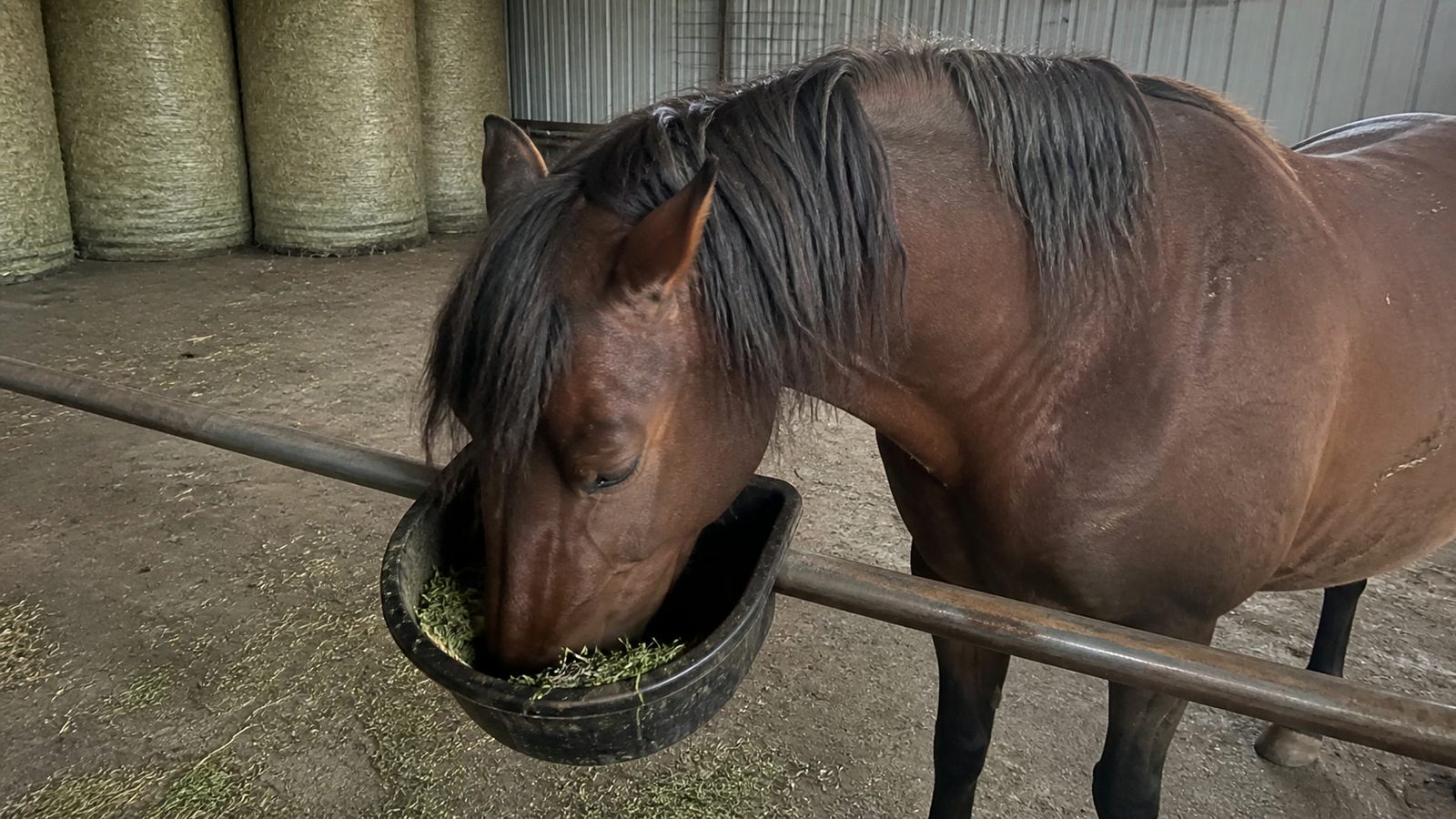
A handful is very unlikely to hurt a healthy horse. It is also, on the arithmetic, almost entirely pointless.
Nothing here is established. No veterinary or extension source sets a share of a horse's ration for fresh leafy greens or microgreens, and not one of the crops below has a horse-specific study behind it at microgreen stage. What this page can do is the sum that decides the question.
Do the arithmetic first
A horse eats roughly 1.5 to 2.5 percent of its body weight in dry matter every day. For a 500 kg animal that is somewhere around 10 kilograms of dry matter, daily, mostly as long-stem forage.
A 1020 tray yields a few ounces of cut shoots, and fresh microgreens are largely water. Even generously, a full tray contributes a rounding error against that requirement, and it does so at a cost per kilogram of dry matter that no forage could justify.
So, the realistic uses are a treat, an enrichment, or a way to get a few grams of something palatable into a horse that is refusing feed. None of those needs a safety verdict on fourteen crops. All of them need you to know it is not nutrition at this scale.
The one that could actually matter: sugar
Non-structural carbohydrate, meaning simple sugars, starches and fructans, is the constraint that governs feeding a horse. Rapid hindgut fermentation of it can cause intestinal disturbance and laminitis, and Oklahoma State's target for affected horses is under 10 percent NSC on a dry-matter basis.
That is an analytical target for a whole forage or ration, not a portion rule. And here is the gap: nobody has analyzed NSC in barley grass, wheatgrass or popcorn shoots grown as microgreens. Cereal shoots are exactly where you would want that number, because young cereal growth is the part of the plant the sugar question usually attaches to.
For a horse with equine metabolic syndrome, insulin dysregulation, or any laminitis history, that makes all three not established rather than reassuring, and it is a conversation with your vet rather than with a tray.
Fodder is not microgreens, and this matters more here than anywhere
Horses are the one animal with a real sprouted-grain literature behind them, so the temptation to borrow it is strongest here.
Fodder is whole germinated grain including the root mat and the remaining seed. A microgreen is the shoot cut above the substrate. The observational work on germinated barley describes the first thing and cannot certify the second, and human microgreen nutrition figures cannot certify a fodder mat in the other direction. Whichever way you carry the evidence, it does not travel.
And underneath both: long-stem forage stays central to a horse's digestive management. Neither practice changes that.
The crop table
Hover or tap a row to highlight it.
| Crop | Verdict | What the evidence supports |
|---|---|---|
| Barley grass | Not established | Germinated-barley fodder evidence is not cut-barley-microgreen evidence. No NSC figure, no serving |
| Wheatgrass | Not established | Mature wheat forage and hay are used. The cut microgreen is not established and has no dose |
| Alfalfa | Not established | Mature alfalfa is a grazed high-protein forage. That says nothing about the shoot stage |
| Clover | Not established | Mature red and white clover pasture is distinct from sweet clover and may carry fungal slaframine risk. No shoot evidence |
| Sunflower | Not established | No equine source. Treated seed is a separate and unacceptable exposure |
| Pea shoots | Not established | No species or stage-specific horse source |
| Radish | Not established | Mature brassica chemistry cannot be used to call the microgreen unsafe either |
| Popcorn shoots | Not established | Do not equate an untested shoot with analyzed corn grain or corn forage |
| Kale | Not established | Merck notes S-methylcysteine sulfoxide as a rare brassica toxin in livestock. Not a quantified kale-microgreen ruling |
| Mustard | Not established | Botanically ambiguous, and no equine source at any stage |
Ten crops, ten identical verdicts, and here that is beside the point rather than frustrating. The scale problem answers the question before the toxicology has to.
What a tray can and cannot do for a horse
Hover or tap a card to highlight it.
What it cannot be
Feed. Around 10 kg of dry matter a day for a 500 kg horse, against ounces of mostly water per tray.
What it can be
A treat, a handful, an enrichment, a way to tempt a horse that is off its feed.
The one real caution
Sugar. NSC is unanalyzed in cereal microgreens, which matters for EMS, insulin dysregulation or a laminitis history.
The thing that does not change
Long-stem forage stays the base of the diet either way.
The confusion to avoid
Sprouted-grain fodder is whole germinated grain with roots and seed. A microgreen is the cut shoot. Neither literature certifies the other.
The terms on this page, in plain words
Tap a term to see what it means.
Dry matter. What is left of a feed once the water is removed. The unit horse rations are calculated in, and the reason a wet tray weighs more than it feeds.
What nobody has established
- NSC content of barley grass, wheatgrass or popcorn shoots at microgreen stage. This is the one number that would change the answer for a metabolic horse.
- Any share of a horse's ration for fresh greens or microgreens, from any source.
- Whether any crop here carries an equine-relevant compound at the shoot stage.
- Whether a tray could ever be economic as horse feed, which the arithmetic above suggests it cannot.
Do not substitute a dog's ten percent treats rule. It is a different animal with a different gut, and no equine equivalent has been published.
Sources
- Oklahoma State University Extension - the under 10 percent NSC dry-matter target for affected horses, and the laminitis reasoning.
- Merck Veterinary Manual, brassica toxicity in livestock - S-methylcysteine sulfoxide as a rare brassica toxin.
- Merck Veterinary Manual, nutritional requirements of horses - dry-matter intake as a share of body weight, and the primacy of forage.
Keep reading
Animals and microgreens
Can Alpacas and Llamas Eat Microgreens?
It would take 50 to 90 trays to supply one alpaca's dry matter for a single day, and up to 250 for a llama. That settles the feed question, and leaves identity and suddenness as the only real risks.
Read Can Alpacas and Llamas Eat Microgreens?Animals and microgreens
Can Bearded Dragons Eat Microgreens?
Probably, as part of the salad. No study has fed a microgreen to a bearded dragon, the one vet-reviewed teaspoon dose has nothing behind it, and calcium to phosphorus is unmeasured for most crops.
Read Can Bearded Dragons Eat Microgreens?Animals and microgreens
Can Cats Eat Microgreens?
Some yes, four unsafe. Parsley is ASPCA-listed toxic to cats and the alliums have a published feline dose, while greens are enrichment for a cat rather than nutrition.
Read Can Cats Eat Microgreens?Animals and microgreens
Can Chickens Eat Microgreens?
Yes, as a treat inside the 10 percent ceiling Cornell sets for all scraps combined. Not one microgreen crop has a chicken-specific safety study behind it, and the 15 percent figure in circulation is unsourced.
Read Can Chickens Eat Microgreens?