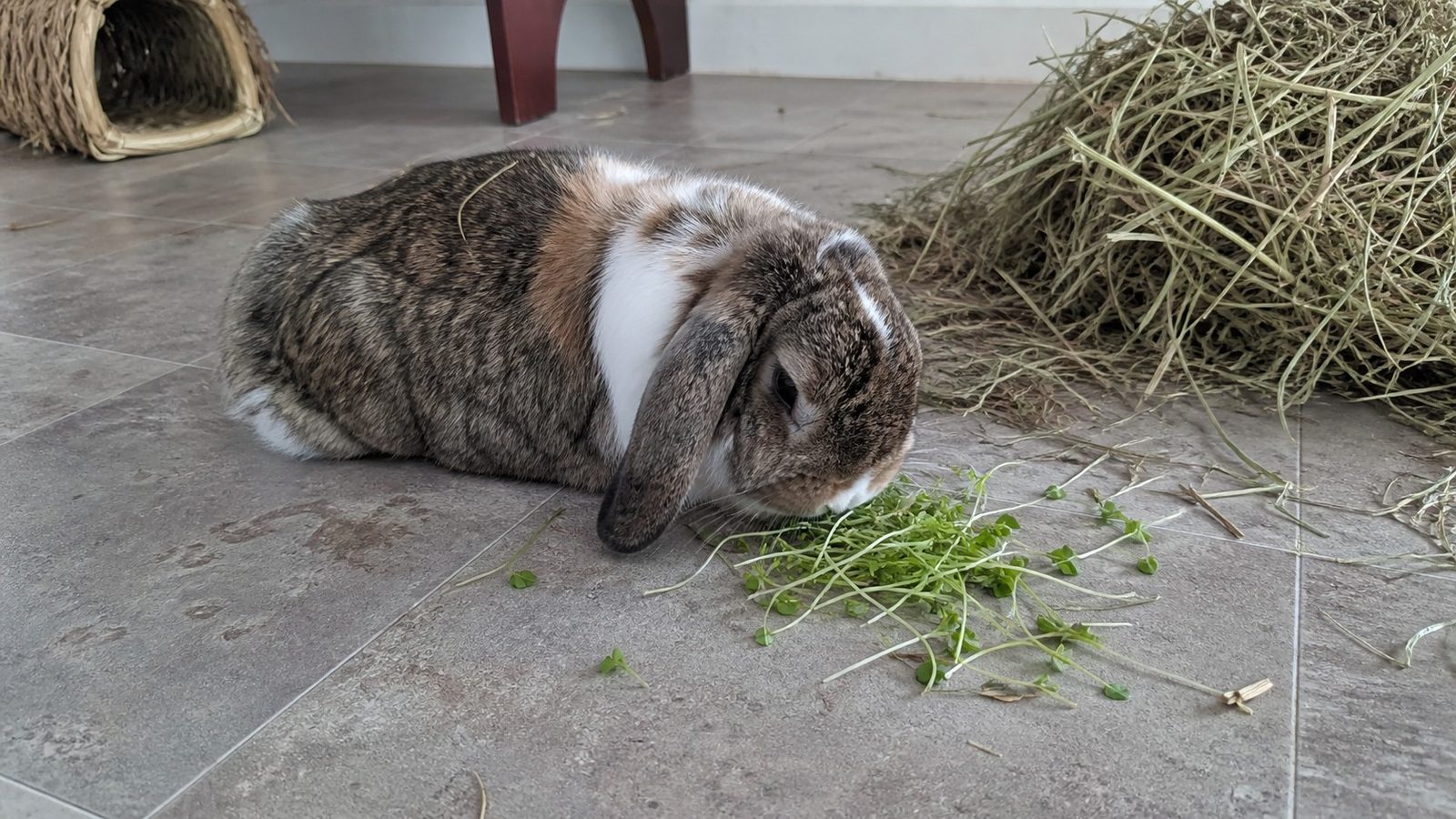
Yes, as part of the greens portion of the diet, and for a rabbit the allowance is measured in a real household unit rather than a percentage.
Merck gives one cup of fresh vegetables per 2 lb of body weight per day. NC State is more conservative for greens specifically at half a cup per 2 lb. Both sit on top of the thing that actually matters, which is 85 to 90 percent grass hay, unlimited.
Note what those figures are measurements of: volumes of ordinary mature fresh greens. Nobody has measured a microgreen for a rabbit, so this is the general greens allowance applied to a food that has not been studied.
Hay first, and why that is the whole answer
A rabbit is a hindgut fermenter that needs fiber moving through it constantly. The thing that kills rabbits is GI stasis, and Merck describes the cascade: reduced gut motility, rising cecal pH, dysbiosis, gas, pain, dehydration and hepatic lipidosis.
This is a syndrome, not a poisoning, which changes what the risk actually is. No source identifies any microgreen compound, any gram dose, or any rate of introduction that causes stasis. What the sources do give is a protocol, and it is the same one for any new green:
- One new food at a time. Oklahoma State says one new item per week.
- Introduce it gradually. NC State says unfamiliar greens go in slowly to prevent diarrhea.
- The hay does not change. Greens are added alongside it, never instead of it.
- Stop and call a vet if diarrhea persists, or if the rabbit goes quiet and stops eating.
A microgreen is a new food. That is the entire risk profile, and it is about the change rather than the crop.
Calcium is the second thing, and it grades the crops
Rabbits absorb calcium differently from most mammals, and the consequence is urinary: bladder sludge, stones and soft-tissue calcification. NC State's advice is to build the salad on lower calcium and lower oxalate greens and rotate the higher ones through in smaller quantities.
That grading is the most useful thing published on the question. It is about the mature plants, and it is the nearest real evidence to each crop.
Hover or tap a row to highlight it.
| Crop | Microgreen verdict | Mature-plant calcium and oxalate, per NC State |
|---|---|---|
| Cilantro | Not established | Very low calcium, very low oxalate. The best-graded green on the list |
| Arugula | Not established | Low calcium, low oxalate |
| Basil | Not established | Low calcium, moderate oxalate |
| Pak choi | Not established | Moderate calcium, low oxalate |
| Mustard | Not established | Moderate calcium, low oxalate. Small amounts |
| Kale | Not established | Moderate calcium, moderate oxalate. Small amounts |
| Parsley | Not established | HIGH calcium, moderate oxalate. Small amounts |
| Spinach | Not established | Low calcium but VERY HIGH oxalate. Small amounts |
| Swiss chard | Not established | Very low calcium but VERY HIGH oxalate |
| Radish | Not established | Oklahoma State mentions mature radish tops as greens. No grading |
| Broccoli | Not established | No specific mature ruling in the qualifying sources |
| Clover | Not established | No qualifying mature composition located. Identify the species |
| Pea shoots | Not established | No qualifying ruling found |
| Alfalfa | Not established | See below. This is the one everybody gets wrong |
Every microgreen verdict is "not established", because no rabbit has ever been fed a measured microgreen in a study. The right-hand column is what you actually have, and it is a reasonable guide as long as you know you are reasoning from the adult plant.
The alfalfa trap
This is the one where the confident answer is wrong.
Alfalfa hay is high in calcium and is generally kept away from ordinary adult rabbits for exactly the urinary reasons above, while young and lactating rabbits are treated differently. Every rabbit keeper knows this. So, the obvious inference is that alfalfa microgreens are also off the menu.
Nobody has measured calcium in alfalfa at microgreen or sprout stage, compared it with the hay, or set any dose. The hay warning is about a dried mature forage fed as the bulk of a diet; a few grams of cut shoot is a different exposure of a different material at a different life stage. So the honest verdict is not established, not "unsafe by analogy", and the same applies to clover.
That cuts both ways: it is not permission either. What it means is that if you avoid alfalfa shoots you are being sensibly cautious, and if someone tells you they are definitely fine, or definitely dangerous, they are reasoning from a hay bale.
What nobody has established
- Any rabbit feeding study of any microgreen.
- Calcium and oxalate content at microgreen stage for any crop, which is the number the whole grading depends on.
- Whether alfalfa or clover shoots carry the calcium load their mature forms do.
- Any rate of introduction, or any quantity, at which a green triggers stasis.
Settling any of it needs analyzed composition of the actual crop stage plus a rabbit feeding and urine study. Until then, hay first, one new thing at a time, and an exotics vet for a rabbit with a history of sludge or stones.
Introducing a new green to a rabbit, which is the actual risk
Hover or tap a card to highlight it.
Hay does not change
85 to 90 percent of the diet stays grass hay, unlimited. Greens are added alongside it and never instead of it.
One new item at a time
Oklahoma State says one per week. A microgreen is a new item, whatever the crop.
Go in gradually
NC State introduces unfamiliar greens slowly, specifically to prevent diarrhea.
Stay inside the volume
Merck's one cup of fresh vegetables per 2 lb of body weight per day, or NC State's half cup for greens.
Stop for diarrhea, or for a rabbit that goes quiet
Not eating is the emergency sign. Call a vet rather than waiting it out.
The terms on this page, in plain words
Tap a term to see what it means.
Hindgut fermenter. An animal that digests fiber in the large intestine and cecum rather than in a rumen. It needs fiber moving constantly, which is why hay outranks everything else.
Sources
- Merck Veterinary Manual, diet for rabbits - one cup of fresh vegetables per 2 lb per day, and the 85 to 90 percent hay base.
- Merck Veterinary Manual, noninfectious diseases of rabbits - the GI stasis cascade.
- NC State CVM, caring for your pet rabbit - half a cup per 2 lb, the calcium and oxalate grading, and slow introduction.
- Oklahoma State University - one new item per week, and when to stop and seek care.
Keep reading
Animals and microgreens
Can Cats Eat Microgreens?
Some yes, four unsafe. Parsley is ASPCA-listed toxic to cats and the alliums have a published feline dose, while greens are enrichment for a cat rather than nutrition.
Read Can Cats Eat Microgreens?Animals and microgreens
Can Dogs Eat Microgreens?
Five groups of these crops are unsafe for dogs with sources, including buckwheat and parsley, which almost nobody names. The sunflower clearance people cite is a different species.
Read Can Dogs Eat Microgreens?Animals and microgreens
Can Guinea Pigs Eat Microgreens?
The one pet where microgreens have a real nutritional case, and it still does not hold. Merck needs 10 mg of vitamin C per kg per day; USDA measured 20.4 to 147 mg per 100 g across 25 microgreens.
Read Can Guinea Pigs Eat Microgreens?Animals and microgreens
Can Hamsters Eat Microgreens?
A teaspoon a day for a dwarf and a teaspoon or two for hamsters generally, inside a 10 percent ceiling. Plus the hoarding problem nobody warns you about, which is the real risk with wet food.
Read Can Hamsters Eat Microgreens?