Can Tortoises and Turtles Eat Microgreens?
Cal HewittPublished Updated Checked
- tortoises
- turtles
- reptiles
- animal feeding
- safety
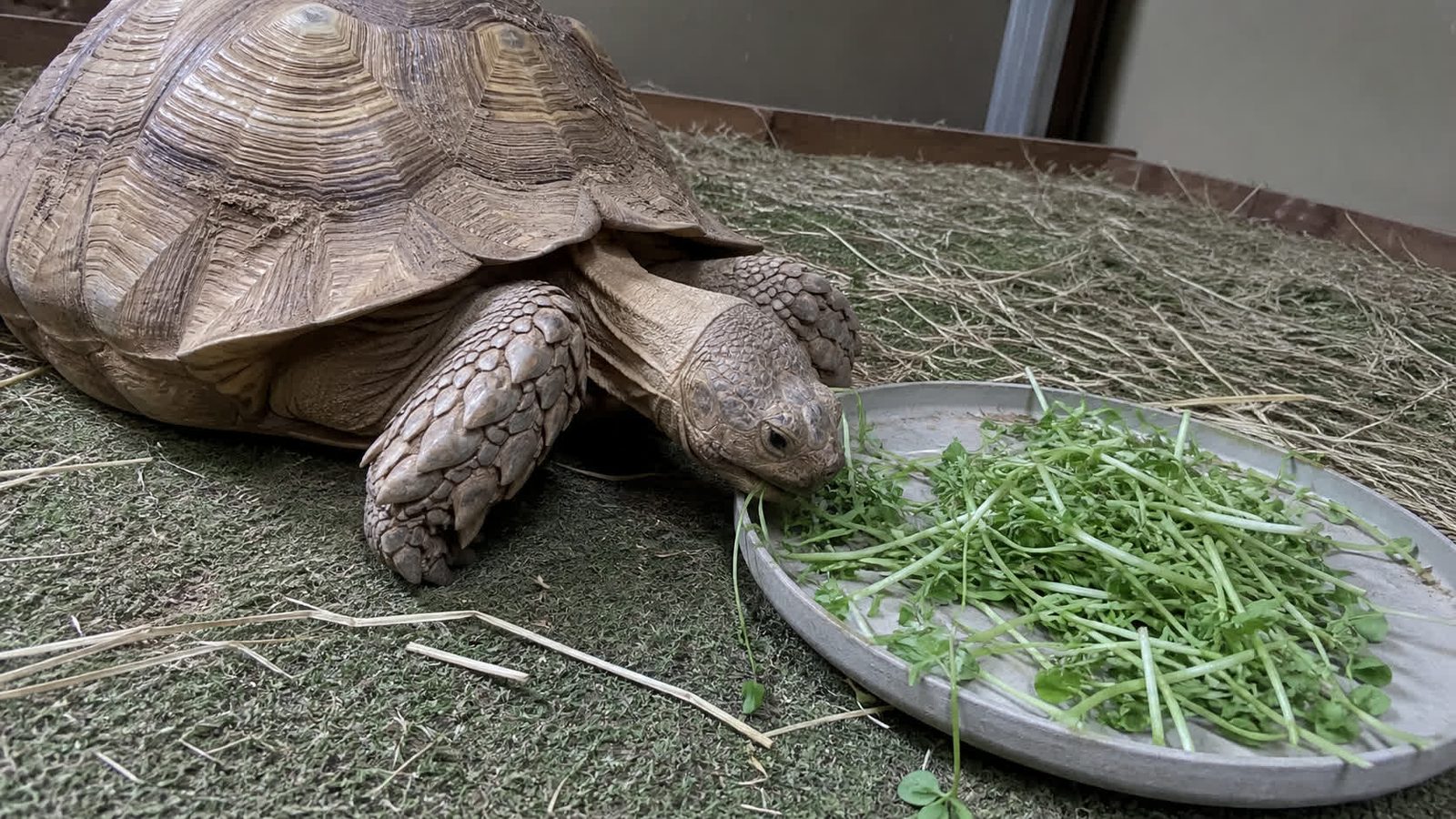
Probably, in small amounts, as part of the plant material. But a sulcata tortoise and a box turtle cannot share an answer, and most of the advice you will find is written for whichever of the two you do not keep.
Work out which animal you have first
The tortoises: sulcata, Russian, leopard. Herbivores whose nutrition comes substantially from microbial fermentation of fiber. Merck recommends grass or herbal hay for herbivorous reptiles, and that is the base of the diet rather than a supplement to it.
The box turtles. Omnivores, roughly half plant material and half animal material. A completely different framework, and most of the "greens for turtles" advice you will find is written for them.
That difference matters more than any crop verdict below. And even among the three tortoises, no source validates a shared microgreen amount, so this page keeps the frameworks separate and does not pretend the crop table resolves them.
The shape of the diet the crops have to fit into
Merck's tortoise chapter opens plainly: "Tortoises are herbivorous". For herbivorous reptiles generally, Merck says herbivorous reptile pellets should make up 25% to 50% of the diet, grass or herbal hay should be fed, and fresh greens, fruits and vegetables together should be no more than 50% of the diet, with fruit no more than 5%. It puts total daily food at 1% to 4% of body weight on a dry-matter basis.
VCA's tortoise advice covers sulcata, leopard, red foot, Greek, Russian and Hermann's tortoises together, not one breed or the Mediterranean species on their own. It says tortoises should mostly eat a mixture of leafy greens such as spring mix, kale, collard or turnip greens and broccoli leaves, along with chemical-free hibiscus flowers and a limited amount of fruit, and that all tortoises can forage outdoors on grass free of fertilizers or pesticides. It gives no percentages.
Box turtles are different animals with a different plate. VCA's box turtle page puts them at about 50% plant material and 50% animal-based food. Within the plant half, vegetables and flowers make up 80% to 90%, and dark leafy greens are the largest part, so vegetables and flowers come to 40% to 45% of the whole diet. For aquatic turtles, diet varies too much by species and age for one leafy-green share to apply; ask your vet about your species.
Whatever the animal, a microgreen is one leafy green among many, sitting inside the fresh-food share. None of these sources supports microgreens as the whole diet.
The fiber problem, which is the real objection
The argument against microgreens for a grazing tortoise is not about toxicity at all.
A tortoise is built to process long, coarse, high-fiber, low-protein forage, slowly. A microgreen is cut at two to three inches after seven to twenty-one days: tender, high in water, and developmentally about as far from hay as a plant gets while still being a plant. On the face of it that is the opposite of what the animal is designed around.
And nobody has tested it. No chelonian study measures what happens when a defined share of a sulcata's, a Russian's or a leopard's forage is replaced with a named microgreen: not fiber intake, not growth, not gut microbiota, not health. So, the concern is real, the mechanism is plausible, and the percentage does not exist. Do not invent one, and be suspicious of anyone who quotes you one.
The practical reading: microgreens are a garnish on top of a hay-and-forage diet, not a component of it, and the fewer questions you ask a tray to answer the better.
Calcium, oxalates and goitrogens
Three levers decide this, and they are the same ones that decide it for a bearded dragon.
Metabolic bone disease is the diet-driven condition that deforms a chelonian skeleton, and it turns on usable calcium, which means calcium relative to phosphorus plus adequate UVB and D3.
Oxalates bind calcium in the gut, and VCA says mature spinach and swiss chard should be fed sparingly for exactly that reason. Goitrogens in the brassicas interfere with thyroid function, and VCA gives that caution on mature mustard and kale.
All three are established for the mature plants and largely unmeasured at microgreen stage, so they are principles to respect rather than limits to work to.
The ratio to check each crop against
Merck's reptile chapter says the calcium to phosphorus ratio of food items "should be at least 1:1, with 2:1 preferred". That is the line used below. A crop at 0.63:1 has more phosphorus than calcium; a crop at 2:1 has twice as much calcium as phosphorus.
Merck's recommended nutrient table gives a second way to see it. For herbivorous reptiles, the closest category for grazing tortoises, it lists calcium at 1.4% to 2.0% and phosphorus at 0.8% to 1.0% of the diet on a dry-matter basis, with crude protein at 18% to 22%. Dividing the ends gives 1.4 ÷ 1.0 = 1.4:1 at the low end and 2.0 ÷ 0.8 = 2.5:1 at the high end. For omnivorous reptiles, the broad category box turtles fall into, calcium runs 1.0% to 1.5% and phosphorus 0.6% to 0.9%, which works out to 1.0 ÷ 0.9 = 1.11:1 and 1.5 ÷ 0.6 = 2.5:1. Those are targets for the whole diet, not a rule every single leaf must pass, which is one more reason to rotate crops rather than lean on one.
Measured calcium and phosphorus, crop by crop
Both studies measured calcium and phosphorus on the same samples and report them in mg per 100 g fresh weight, meaning the green as eaten, water included. Both are human-food studies; nobody measured a microgreen being fed to a tortoise.
The first is Di Gioia and colleagues, 2023, Frontiers in Plant Science, Table 3. The crops were grown in a USDA greenhouse in Fort Pierce, Florida, on a natural fiber mat with a half-strength nutrient solution, and cut 10 to 19 days after sowing. The second is Balik and colleagues, 2025, Scientific Reports, Table 2, grown in a growth room in Turkey on a peat-based medium and harvested 7 to 21 days after germination depending on the crop.
Hover or tap a row to highlight it.
| Crop | Study | Calcium (mg/100 g FW) | Phosphorus (mg/100 g FW) | Arithmetic | Ca:P |
|---|---|---|---|---|---|
| Arugula | Di Gioia 2023 | 75.27 | 40.93 | 75.27 ÷ 40.93 | 1.84:1 |
| Broccoli | Di Gioia 2023 | 63.20 | 37.55 | 63.20 ÷ 37.55 | 1.68:1 |
| Broccoli | Balik 2025 | 111.83 | 27.7 | 111.83 ÷ 27.7 | 4.04:1 |
| Red cabbage | Di Gioia 2023 | 142.66 | 48.23 | 142.66 ÷ 48.23 | 2.96:1 |
| Red Russian kale | Di Gioia 2023 | 69.54 | 55.37 | 69.54 ÷ 55.37 | 1.26:1 |
| Garnet Giant mustard | Di Gioia 2023 | 81.20 | 44.09 | 81.20 ÷ 44.09 | 1.84:1 |
| Red Arrow radish | Di Gioia 2023 | 43.95 | 54.25 | 43.95 ÷ 54.25 | 0.81:1 |
| Black radish | Balik 2025 | 93.94 | 31.3 | 93.94 ÷ 31.3 | 3.00:1 |
| Black oil sunflower | Di Gioia 2023 | 41.76 | 66.05 | 41.76 ÷ 66.05 | 0.63:1 |
| Sunflower | Balik 2025 | 148.63 | 35.0 | 148.63 ÷ 35.0 | 4.25:1 |
| Bull's Blood beet | Di Gioia 2023 | 56.20 | 40.91 | 56.20 ÷ 40.91 | 1.37:1 |
| Red beet | Balik 2025 | 67.18 | 25.7 | 67.18 ÷ 25.7 | 2.61:1 |
| Pea | Balik 2025 | 99.07 | 46.1 | 99.07 ÷ 46.1 | 2.15:1 |
| Dark Opal basil | Di Gioia 2023 | 92.27 | 28.35 | 92.27 ÷ 28.35 | 3.25:1 |
| Genovese basil | Di Gioia 2023 | 141.67 | 36.10 | 141.67 ÷ 36.10 | 3.92:1 |
| Garnet Red amaranth | Di Gioia 2023 | 141.81 | 62.79 | 141.81 ÷ 62.79 | 2.26:1 |
Across the 17 crops in the Di Gioia study, basil had the lowest phosphorus, 28.35 mg in Dark Opal, and sunflower the highest, 66.05 mg. The Balik figures here come from its Table 2. Its written text gives sunflower 145.29 mg of calcium, but in the table that figure belongs to bean and sunflower is 148.63; its abstract prints phosphorus a tenth of the table's 25.7 to 48.8 mg range. Go by the table.
Where the two studies disagree
Sunflower is the crop to be careful with. In Di Gioia it came in at 0.63:1, below Merck's 1:1 floor, with the most phosphorus of any crop in that study. In Balik it came in at 4.25:1, well above 2:1. Radish swings the same way: Red Arrow at 0.81:1 in one study, black radish at 3.00:1 in the other. Broccoli moves from 1.68:1 to 4.04:1 and beet from 1.37:1 to 2.61:1, though both of those stay above 1:1 either way.
The studies used different cultivars, growing media, nutrient solutions, harvest ages and labs, so one study's ratio cannot stand for a crop in general, and your own tray, grown your way, could sit anywhere in that spread. Treat sunflower and radish as crops that may be phosphorus-heavy, offer them in small amounts alongside higher-calcium greens, and do not build the tray around either.
How each crop reads against the line
Arugula (1.84:1) and mustard (1.84:1) both clear 1:1 and sit close to Merck's preferred 2:1. VCA lists mustard greens for box turtles. No tortoise or turtle source names arugula at any stage, so ask your vet before adding it.
Broccoli (1.68:1 and 4.04:1) clears 1:1 in both studies. It is also the crop with the most support as a mature plant: VCA lists broccoli for box turtles, VCA's tortoise page names broccoli leaves, and Merck includes broccoli in the vegetable mix that can supplement a formulated tortoise diet.
Red cabbage (2.96:1) and kale (1.26:1) both clear 1:1, cabbage comfortably. VCA lists cabbage, kale and mustard greens for box turtles but warns that all three contain goitrogens, compounds that may lead to hypothyroidism, so it advises variety and moderation. That warning is written for these three crops as mature greens, and no one has measured goitrogens in their microgreens, so treat it as applying and keep them in rotation rather than daily.
Beet (1.37:1 and 2.61:1) clears 1:1 in both studies. VCA says beet greens, spinach and Swiss chard should be fed sparingly because their oxalates bind calcium and other minerals, and that diets built mainly on them can cause deficiencies in box turtles. Merck recommends low-oxalate vegetables for herbivorous reptiles to reduce the chance of kidney stones. Keep beet as an occasional green.
Pea (2.15:1) clears 2:1 in the one study that measured it. VCA lists peas, the vegetable, among foods for a lesser share of a box turtle's diet; no source addresses pea shoots for tortoises or turtles.
Basil (3.25:1 and 3.92:1 for two cultivars) and amaranth (2.26:1) have some of the strongest ratios on the table, and basil the lowest phosphorus. No tortoise or turtle source addresses either crop, so a good ratio is all you have to go on. Ask your vet before offering them.
Radish and sunflower are covered above. Merck's plant table lists mature radish at 1.63:1 for reptiles generally, but no tortoise or turtle source names either crop.
The crop table
Hover or tap a row to highlight it.
| Crop | Verdict | The nearest real evidence, and who it is about |
|---|---|---|
| Clover | Not established | VCA lists mature clover for BOX TURTLES. Not evaluated for tortoises |
| Broccoli | Not established | Mature broccoli appears in Merck's tortoise mix and VCA's box turtle list |
| Collard | Not established | Mature collard greens, box turtles |
| Turnip | Not established | Mature turnip greens, box turtles |
| Endive | Not established | Mature endive in Merck's tortoise vegetable mix |
| Mustard | Not established | Mature mustard acceptable for box turtles, with a goitrogen caution |
| Kale | Not established | Mature kale in Merck's tortoise mix and VCA's list, with the same caution |
| Cilantro | Not established | Mature cilantro, box turtles |
| Spinach | Not established | Sparingly, on oxalates. Box turtles |
| Swiss chard | Not established | Sparingly, on oxalates |
| Arugula | Not established | No chelonian source at any stage |
| Radish | Not established | No chelonian source at any stage |
| Alfalfa | Not established | Merck and VCA name alfalfa HAY. Hay is not the shoot |
| Wheatgrass | Not established | Merck recommends grass and herbal hay generally, not cut wheat shoots |
Read the right-hand column as carefully as the verdict. Seven of these rows are box turtle evidence, and a box turtle is an omnivore. If you keep a sulcata, most of the greens advice circulating about "turtles" was not written about your animal.
The nine crops with no measured pair
For wheatgrass, alfalfa, clover, cilantro, parsley, spinach, Swiss chard, buckwheat and chia, no microgreen calcium and phosphorus pair has been published in either study. For these, work from the mature-plant guidance and keep these as a small, occasional part of the mix.
Some of that guidance is useful. Merck says grass hay or herbal hay should be fed to herbivorous reptiles, and VCA says tortoises can graze fertilizer-free grass, but cut wheat shoots are not the same thing as grass or hay. Merck says large tortoises such as Aldabra or Galapagos can eat alfalfa hay, and VCA lists alfalfa hay and clover for box turtles; hay is a mature, dried plant and not the same food as a microgreen. VCA lists cilantro for box turtles, and puts spinach and Swiss chard in the feed-sparingly group for oxalates. Buckwheat and chia have no tortoise or turtle source at all.
Sprouts and parsley
Sprouts
Sprouts are not microgreens. A microgreen is cut above the growing medium, while a sprout is eaten with the seed and root. VCA lists "sprouts" among foods that can make up a lesser share of a box turtle's diet, without naming a crop, amount or growth stage. ReptiFiles, a husbandry site whose author is not a veterinarian, lists bean sprouts under foods not to feed red-eared sliders, without giving a reason. If you keep a slider, leave bean sprouts out, and for any species cut your greens above the medium rather than pulling whole seedlings.
Parsley
The ASPCA classes parsley as toxic to dogs, cats and horses. The effect is photosensitization, meaning sunburn and skin irritation, and ASPCA notes that large amounts are needed to cause it. It has no tortoise or turtle listing. VCA lists parsley as acceptable for box turtles. Both facts stand. Keep parsley a small, occasional green, and ask your reptile vet before adding it for a tortoise.
Which framework applies to your animal
Hover or tap a card to highlight it.
Sulcata, Russian, leopard tortoise
Herbivores. Grass and herbal hay is the base, fiber fermentation does the work, and greens sit on top.
Box turtle
Omnivore, roughly half plant and half animal material. A different diet, and the source of most greens advice you will read.
What they share
Calcium against phosphorus, plus UVB and D3, decides skeletal health in both.
What no source shares
Any validated microgreen amount, for any of the four, at any stage.
The safe reading
A garnish on a correct diet. Never a replacement for hay, forage or animal protein.
What nobody has established
- Whether replacing any share of a grazing tortoise's forage with microgreens changes fiber intake, growth, gut microbiota or health. Nobody has run it.
- Calcium to phosphorus ratios at microgreen stage for most of these crops.
- Whether the box turtle evidence transfers to tortoises at all, which is assumed far more often than it is stated.
- Any amount, for any species here, from any source.
A tortoise with suspected metabolic bone disease, or any abnormal calcium result, needs a reptile veterinarian rather than a change of greens.
Adding a new green without upsetting the diet
Start with a small amount of one new crop mixed into the greens your animal already eats, rather than a plateful on its own. Rotate between several crops over the week so no single ratio, oxalate or goitrogen load dominates. Favor the crops that cleared 1:1 in every measurement, go lightly on sunflower and radish, and keep the whole fresh-greens share inside the limits your vet has set. If you grow trays for your animals, see growing microgreens for animals, and if you also keep a lizard, the bearded dragons page covers the same crops for that species.
Before any change for your own animal, talk to a veterinarian who treats reptiles. Species, age, size and health all shift what is right, and they can examine the animal in a way no table can.
Signs something is wrong
There is no microgreen-specific list of reaction signs for tortoises. VCA says signs of illness in tortoises are more commonly non-specific, "such as a tortoise with a lack of appetite and lethargy", and that "Any tortoise that shows a deviation from normal should be evaluated by a veterinarian familiar with reptile diseases." So, if your tortoise stops eating, slows down or simply is not acting like itself after a diet change, stop the new green and call your reptile vet. If you think an animal has eaten something toxic, the ASPCA advises calling its Poison Control Center or your veterinarian as soon as possible.
Frequently asked questions
Is there a vet-approved list of microgreens for tortoises? No. No veterinary source addresses microgreens for any tortoise or turtle. Vet sources cover mature greens, hay and vegetables, so use those and your reptile vet's advice as the guide.
Which microgreen has the best calcium to phosphorus ratio? In the measured crops, Genovese basil (3.92:1) and Dark Opal basil (3.25:1) had among the highest ratios, and sunflower reached 4.25:1 in one study. Sunflower also came in at 0.63:1 in the other, so a single high figure is not a reason to feed a crop heavily.
Are these figures on the same basis as Merck's targets? No. The microgreen figures are fresh weight, with the water left in, while Merck's diet targets are dry matter. The ratio still compares fairly, because water divides out of calcium and phosphorus alike, but the percentages do not.
Can I give my tortoise the whole tray, roots and all? Cut above the medium instead. A cut microgreen leaves the seed, root and growing medium behind, and no source has tested those tray materials in tortoises or turtles. Keep any visibly moldy greens away from your animal.
How often can I offer microgreens? No source gives a microgreen amount or frequency. Keep them a small, rotating part of the fresh-greens share, which Merck caps at 50% of the diet for herbivorous reptiles, and set the amount with your vet.
The short version
Eleven common microgreens have measured calcium and phosphorus, and most clear Merck's 1:1 floor in every study that measured them. Sunflower and radish are the exceptions to watch, dropping below 1:1 in one study each. Kale, cabbage and mustard carry VCA's goitrogen caution, and beet, spinach and chard its oxalate caution. Offer any new green as a small share of a varied diet, rotate, and check with a reptile vet before you change what your own animal eats.
The terms on this page, in plain words
Tap a term to see what it means.
Chelonian. The order covering tortoises, turtles and terrapins. Used here because the four species on this page are not interchangeable but do share some biology.
Sources
- Merck Veterinary Manual, nutrition in tortoises - the vegetable mix.
- VCA, feeding box turtles - the roughly half plant, half animal baseline, the acceptable greens, and the oxalate and goitrogen cautions.
- University of Maryland Extension, growing microgreens - the two to three inch, seven to twenty-one day harvest stage that makes a microgreen developmentally unlike hay.
- Merck says
- VCA's tortoise advice
- VCA's box turtle page
- recommended nutrient table
- Di Gioia and colleagues, 2023, Frontiers in Plant Science
- Balik and colleagues, 2025, Scientific Reports
- ReptiFiles
- ASPCA classes parsley
- more commonly non-specific
Keep reading
Animals and microgreens
Can Bearded Dragons Eat Microgreens?
Probably, as part of the salad. No study has fed a microgreen to a bearded dragon, the one vet-reviewed teaspoon dose has nothing behind it, and calcium to phosphorus is unmeasured for most crops.
Read Can Bearded Dragons Eat Microgreens?Animals and microgreens
Can You Gut-Load Feeder Insects With Microgreens?
You can feed them to insects. You cannot deliver calcium that way, and calcium is the entire reason gut-loading exists. A cricket needs a 13-fold ratio change, and the best published gut-load managed three to four.
Read Can You Gut-Load Feeder Insects With Microgreens?Animals and microgreens
Can Alpacas and Llamas Eat Microgreens?
It would take 50 to 90 trays to supply one alpaca's dry matter for a single day, and up to 250 for a llama. That settles the feed question, and leaves identity and suddenness as the only real risks.
Read Can Alpacas and Llamas Eat Microgreens?Animals and microgreens
Can Cats Eat Microgreens?
Some yes, four unsafe. Parsley is ASPCA-listed toxic to cats and the alliums have a published feline dose, while greens are enrichment for a cat rather than nutrition.
Read Can Cats Eat Microgreens?