Can Guinea Pigs Eat Microgreens?
Cal HewittPublished Updated Checked
- guinea pigs
- pets
- animal feeding
- safety
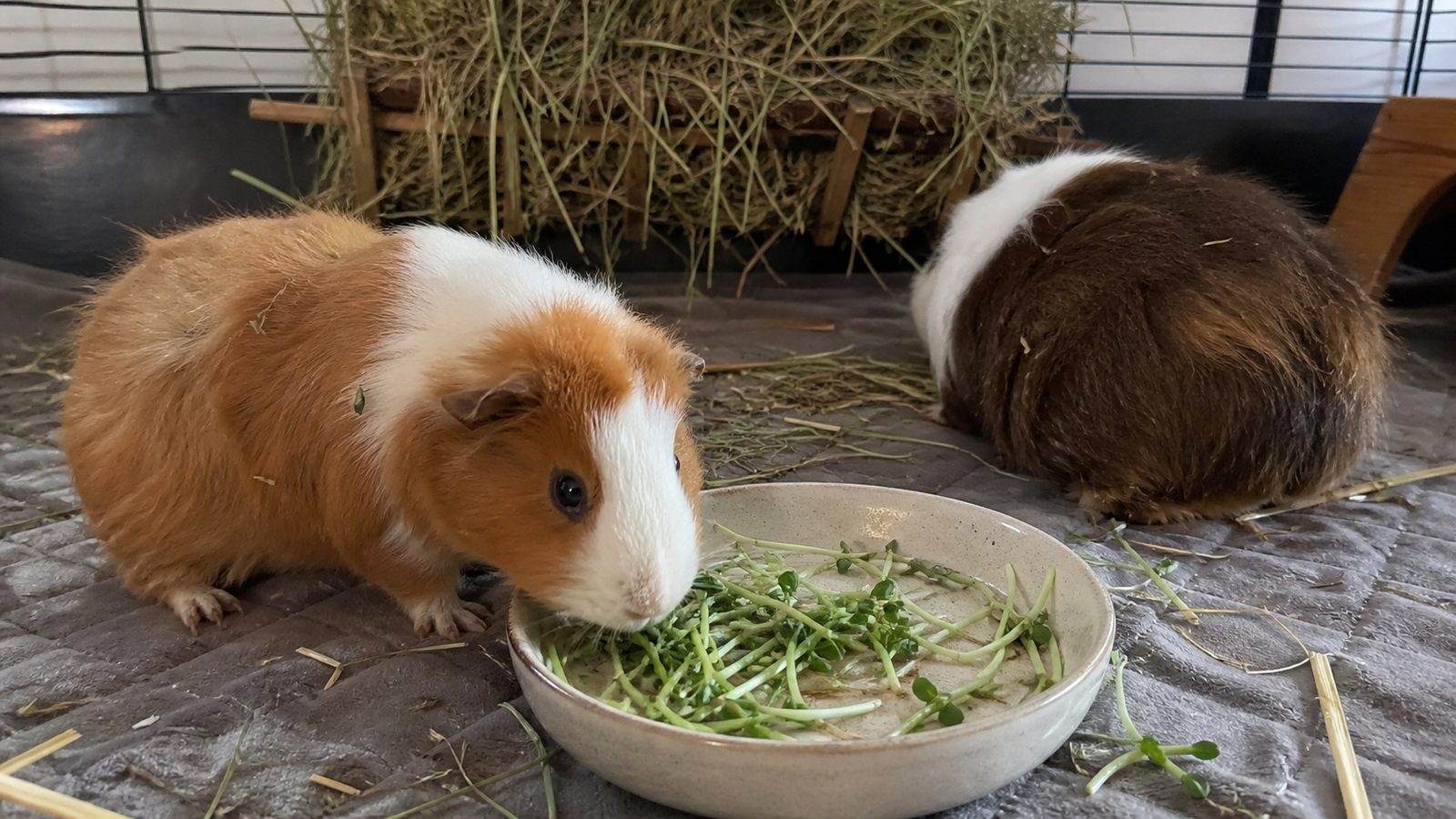
Yes, as part of the fresh vegetable portion. And a guinea pig is the one pet where microgreens have a genuine nutritional argument behind them, because it cannot make its own vitamin C.
That argument does not survive a close look, and the reason is worth knowing before you rely on a tray for it.
The vitamin C question, which is the whole reason anyone asks
Guinea pigs cannot make their own vitamin C. That is the defining fact about the species, and deficiency causes scurvy. Merck sets the minimum at 10 mg per kg of body weight per day, and 30 mg per kg per day for pregnant females.
So, the obvious pitch writes itself: microgreens are nutrient-dense, guinea pigs need vitamin C, feed microgreens. Several sites make exactly that argument.
Here is what is actually measured. The USDA's 2012 analysis of 25 commercial microgreens found total ascorbic acid ranging from 20.4 to 147.0 mg per 100 g fresh weight, with red cabbage and garnet amaranth among the high examples. That is a real number from a real study, and it proves that some microgreens contain useful amounts of vitamin C.
It does not tell you what is in your tray. Run the arithmetic and you can see why. At the low end of that range, meeting 10 mg would take roughly 49 g of fresh microgreens. At the high end, about 6.8 g. That is a sevenfold spread, and it is a spread across different products tested by somebody else rather than a range within one crop you might grow.
Nothing links a measured assay to your tray's variety, harvest age, storage history or guinea pig portion. So, "microgreens cover the vitamin C requirement" is a marketing claim, not veterinary guidance. Fresh pellets and the vitamin-C-rich mature foods your vet recommends are what the requirement is actually met with. Microgreens can sit alongside that; they cannot replace it, and nobody can tell you how much your tray contributes.
How much vitamin C a guinea pig needs, and what a serving holds
Guinea pigs cannot make their own vitamin C, and the Merck Veterinary Manual says they "must get it from their diet." Its minimum is at least 10 mg of vitamin C per kg of body weight per day, rising to 30 mg per kg for pregnant females. Merck also notes that most guinea pigs weigh around 1 kg, so the arithmetic for a typical adult is short:
10 mg per kg × 1 kg = 10 mg of vitamin C a day (30 mg if she is pregnant)
Other veterinary sources give wider ranges. VCA says guinea pigs need 10 to 50 mg a day depending on age, health, stress and pregnancy, and UC Davis says 10 to 30 mg supplemented daily.
Now set a serving against that. The USDA study of 25 commercial microgreens (Xiao and colleagues, 2012) measured 20.4 to 147.0 mg of vitamin C per 100 g fresh weight. A weighed 10 g portion at the bottom of that range holds about 2 mg, a fifth of a 1 kg guinea pig's daily minimum. The same 10 g at the top holds 14.7 mg, which clears it.
The table shows how many grams of fresh microgreens would hold 10 mg, using single study values. These are laboratory numbers from one harvest each, not what your tray will necessarily test at.
Hover or tap a row to highlight it.
| Crop | Vitamin C, mg per 100 g fresh weight | Study | Grams for 10 mg |
|---|---|---|---|
| Red cabbage | 147.0 | Xiao 2012 | 6.8 |
| Garnet amaranth | 131.6 | Xiao 2012 | 7.6 |
| China rose radish | 95.8 | Xiao 2012 | 10.4 |
| Opal basil | 90.8 | Xiao 2012 | 11.0 |
| Pea | 70.76 | Balik 2025 | 14.1 |
| Sunflower | 67.55 | Balik 2025 | 14.8 |
| Alfalfa | 56.75 | Fabek Uher 2023 | 17.6 |
| Kale | 56.14 | de la Fuente 2019 | 17.8 |
| Broccoli | 50.99 | de la Fuente 2019 | 19.6 |
| Cilantro | 40.6 | Xiao 2012 | 24.6 |
| Mustard (red) | 30.67 | de la Fuente 2019 | 32.6 |
| Red beet | 28.8 | Xiao 2012 | 34.7 |
The same crop can land in very different places depending on the study. Broccoli microgreens have measured anywhere from 38.2 to 256.46 mg per 100 g, and red cabbage from 49.24 to 147.0, so there is no one number per crop. A pregnant female needs three times each weight in the last column.
NC State Veterinary Hospital recommends about 1/2 cup of greens per 2 lb of body weight a day, introduced slowly to prevent diarrhea, with leafy greens making up about 10% of the diet. Nobody publishes what half a cup of microgreens weighs, and it changes with the crop, so put half a cup of your own harvest on a kitchen scale once and write the figure down. Then you can do the vitamin C sum for your own bowl.
Calcium is the second thing, and it decides alfalfa
Calcium is necessary and excess calcium from a repeated diet contributes to bladder stones, which are common and painful in this species.
The MSD Veterinary Manual names parsley, kale and spinach as high-calcium greens not to feed often, and calls alfalfa-based feeding inappropriate for adults on the same grounds, with young, growing and pregnant animals as the stated exception.
Which produces a familiar trap. Alfalfa hay is high in calcium, so alfalfa microgreens must be too. No guinea pig study gives a safe calcium load, a calcium to phosphorus ratio, or any amount for alfalfa or clover shoots. The hay rule is about a dried mature forage fed as a diet base. It is not established for the shoot, in either direction, and a guinea pig with a history of stones needs a vet's plan rather than an inference.
Calcium and oxalate, the other half of the answer
Vitamin C is only half the question. The MSD Veterinary Manual says "High-calcium greens (parsley, kale, spinach) should not be given often, because excess calcium may contribute to bladder stone formation." VCA says leafy greens "should be lower in calcium or oxalates to prevent urinary stones." NC State recommends lower calcium, lower oxalate greens "as the basis of your pet's salad," with higher calcium or oxalate greens rotated in "in smaller quantities."
NC State's grades come from human food databases for mature greens. For the microgreens themselves, calcium, phosphorus and oxalic acid have been measured for about ten crops, each in one or two studies, and the studies disagree. Balik's 2025 broccoli calcium is about 3 times de la Fuente's 2019 figure, and de la Fuente did not measure phosphorus at all.
Hover or tap a row to highlight it.
| Microgreen | Calcium, mg/100 g FW | Phosphorus, mg/100 g FW | Oxalic acid, mg/100 g FW | Study |
|---|---|---|---|---|
| Broccoli | 37.38 | not measured | not measured | de la Fuente 2019 |
| Broccoli | 111.83 | 27.7 | not measured | Balik 2025 |
| Broccoli | not measured | not measured | 55.04 | Gunjal 2024 |
| Kale | 40.38 | not measured | not measured | de la Fuente 2019 |
| Mustard (red) | 32.20 | not measured | not measured | de la Fuente 2019 |
| Radish | 31.02 | not measured | not measured | de la Fuente 2019 |
| Radish (black) | 93.94 | 31.3 | not measured | Balik 2025 |
| Beet (red) | 67.18 | 25.7 | not measured | Balik 2025 |
| Pea | 99.07 | 46.1 | not measured | Balik 2025 |
| Sunflower | 148.63 | 35.0 | not measured | Balik 2025 |
| Cabbage | not measured | not measured | 51.57 | Gunjal 2024 |
| Amaranth (red) | not measured | not measured | 19.16 | Gunjal 2024 |
Sources: de la Fuente et al. 2019, Balik et al. 2025, Gunjal et al. 2024.
For the crops with no microgreen measurement, use the mature grade as your guide and keep the high ones in rotation rather than daily.
The crop table
The verdicts are all the same. The grading in the right-hand column is what you actually have, and it is about the mature plants.
Hover or tap a row to highlight it.
| Crop | Verdict | Mature-plant evidence, per NC State, VCA, MSD and UC Davis |
|---|---|---|
| Cilantro | Not established | Very low calcium, very low oxalate, and named as a vegetable choice. The best-graded on the list |
| Arugula | Not established | Low calcium, low oxalate |
| Basil | Not established | Low calcium, moderate oxalate |
| Pak choi | Not established | Moderate calcium, low oxalate |
| Broccoli | Not established | Named among mature vegetable choices. No microgreen dose |
| Radish | Not established | UC Davis names mature radish tops, not the microgreen |
| Kale | Not established | Moderate calcium and oxalate, and MSD says high-calcium kale should not be frequent |
| Parsley | Not established | HIGH calcium, moderate oxalate. Not to be fed often |
| Spinach | Not established | Very high oxalate, and flagged as not frequent |
| Swiss chard | Not established | Very high oxalate |
| Sunflower | Not established | No qualifying guinea pig source at any stage |
| Pea shoots | Not established | No qualifying source |
| Clover | Not established | No qualifying source. Do not transfer alfalfa-hay rules to it |
| Alfalfa | Not established | Adult hay and pellets are higher calcium. See above |
The crops, one at a time
Read every verdict below as a verdict on the grown-up vegetable. A mature kale leaf and a nine-day kale seedling are the same species, but growth stage, cultivar, growing medium and harvest age all change what is in the plant, so a grade for the leaf is a starting point for the seedling, not a guarantee. Whatever crop you pick, the next step is the same: a small amount, introduced slowly, with your vet in the loop.
Each entry gives the mature plant's record for guinea pigs first, then what the microgreen has measured.
Radish
UC Davis lists "radish tops" among "Some vegetables you may feed your guinea pig," with no amount or frequency given. The microgreens measured well for vitamin C in the USDA study: China rose 95.8, opal 90.1 and green daikon 70.7 mg per 100 g. Other studies came in lower, at 45.43 (de la Fuente 2019) and 33.37 for black radish (Balik 2025). Calcium measured 31.02 in one study and 93.94 in the other.
Broccoli
The UC Davis nutrition page rates broccoli leaves and florets "Good" for vitamin C, one step below its "Excellent" group. VCA lists broccoli under "Other vegetables," and Merck names it among foods high in vitamin C. The microgreens measured 50.99 (de la Fuente 2019), 49.02 (Balik 2025) and 38.2 in the untreated control of a hydroponic trial (Kathi 2023). One more study reported 256.46, well above the rest. Calcium runs from 37.38 to 111.83 depending on the study.
Kale
UC Davis rates kale "Excellent" for vitamin C. NC State grades mature kale moderate for both calcium and oxalate, and MSD names kale among the high calcium greens that "should not be given often." The microgreen measured 56.14 mg of vitamin C and 40.38 mg of calcium per 100 g in de la Fuente 2019, where the mature kale compared against it held 169 to 254 mg of calcium. Treat it as a rotation green, not a daily base.
Cabbage
The two veterinary sources pull in different directions here. UC Davis says cabbage offers some vitamin C but "the amount is nominal" next to its top foods, while Merck lists red cabbage among foods high in vitamin C. The microgreen numbers explain some of the confusion: red cabbage measured 147.0 mg per 100 g in the USDA study, the highest of its 25 crops, but 49.24 in a 2023 floating hydroponics study harvested 20 days after sowing. At the lower figure you would need 20.3 g to reach 10 mg.
Mustard
UC Davis rates mustard greens "Excellent" for vitamin C, and NC State grades them moderate calcium, low oxalate, so its rotation advice applies. The microgreens measured 72.1 (purple) and 62.2 (red) in the USDA study, and 30.67 for red mustard in de la Fuente 2019, with 32.20 mg of calcium.
Arugula
NC State grades arugula low calcium, low oxalate, which puts it in the group it recommends as the base of the salad. The microgreen measured 45.8 mg of vitamin C per 100 g in the USDA study.
Sunflower
There is no guinea pig feeding record for sunflower greens. The sunflower in the ASPCA plant database is swamp sunflower (Helianthus angustifolius), a different species from the seed sunflower grown for microgreens. The microgreen measured 67.55 mg of vitamin C in Balik 2025, and 148.63 mg of calcium, the highest calcium of any microgreen in the table above. Keep it small and occasional.
Pea shoots
No guinea pig source covers pea shoots. The ASPCA "Sweet Pea" entry is perennial pea (Lathyrus latifolius), toxic to horses, which is not the garden pea (Pisum sativum) grown for shoots. Pea tendrils measured 50.5 mg of vitamin C in the USDA study, and golden pea tendrils grown in the dark only 25.1. Balik 2025 measured 70.76, with 99.07 mg of calcium.
Alfalfa
The veterinary record here is about the mature hay and pellets, and it is cautious. NC State says alfalfa hay "contains too much calcium and protein for an adult animal and should only be fed to young guinea pigs (<6 months) and lactating females." UC Davis says alfalfa hay and alfalfa-based pellets "should be avoided" as too high in calcium. MSD keeps alfalfa-based pellets for young, growing or pregnant guinea pigs because they are higher in calcium. The microgreen measured 56.75 mg of vitamin C (Fabek Uher 2023). With that record on the mature plant, an adult guinea pig is better served by other greens.
Basil
NC State grades basil low calcium, moderate oxalate, and ASPCA lists it as non-toxic to dogs and cats. Basil microgreens measured well for vitamin C in the USDA study: 71.0 for green and 90.8 for opal.
Cilantro
NC State grades cilantro very low in both calcium and oxalate, and VCA lists it under "Other vegetables." ASPCA lists cilantro as non-toxic to dogs, cats and horses. It is not a strong vitamin C crop as a microgreen: 40.6 mg per 100 g in the USDA study, 21st of 25. It fits the salad base on its calcium and oxalate grades; count on something else for the vitamin C.
Parsley
UC Davis rates parsley "Excellent" for vitamin C and lists it among vegetables you may feed, and VCA and Merck both name it as a vitamin C vegetable. NC State grades it high calcium, moderate oxalate, and MSD names it among greens that "should not be given often." ASPCA lists parsley as toxic to dogs, cats and horses, causing photosensitization, and notes "large amounts are needed to cause this effect." ASPCA has no guinea pig listing either way. No microgreen vitamin C figure exists for parsley, so treat it as the mature record suggests: occasional, not daily.
Spinach and Swiss chard
NC State grades spinach low calcium but very high oxalate, and Swiss chard very low calcium but very high oxalate. MSD, by contrast, names spinach as a high calcium green. The two sources disagree on spinach's calcium, but both limit it. ASPCA's beet entry covers Swiss chard as non-toxic to dogs, cats and horses and notes that "Large mature leaves contain oxalic acid." Magenta spinach microgreens measured 41.6 mg of vitamin C in the USDA study; chard has no microgreen figure. Keep both as small, occasional additions.
Beet
UC Davis rates beet greens "Good" for vitamin C and lists them among vegetables you may feed, and VCA lists them under "Other vegetables." NC State grades them low calcium, high oxalate. The microgreens measured on the low side for vitamin C in most studies: bull's blood 46.4 and red beet 28.8 in the USDA study, 32.72 in Balik 2025 and 28.20 for yellow beet in Fabek Uher 2023. Red beet calcium measured 67.18.
Buckwheat
No guinea pig source covers buckwheat, and no microgreen vitamin C figure exists. ASPCA lists buckwheat as toxic to dogs, cats and horses, from a compound called fagopyrin that causes photosensitization. ASPCA has no guinea pig listing, so that does not settle it for your pet, but with nothing on the guinea pig side to support it, leaving buckwheat out of the bowl is the cautious choice.
Amaranth
No guinea pig source covers amaranth. As a microgreen, garnet amaranth measured 131.6 mg of vitamin C per 100 g in the USDA study, second only to red cabbage, and one study measured red amaranth oxalic acid at 19.16. If you try it, start with a few strands and ask your vet.
Wheatgrass, clover and chia
None of these has a guinea pig feeding record or a measured microgreen vitamin C figure. With nothing to go on for either, choose a crop from the list above that has a mature record, and raise these with your vet before offering them.
What the vitamin C claim does and does not support
Hover or tap a card to highlight it.
The requirement is real
Merck, 10 mg per kg of body weight daily, 30 mg per kg for pregnant females. Guinea pigs cannot synthesize it.
Some microgreens do carry it
USDA measured 20.4 to 147.0 mg per 100 g across 25 commercial microgreens. Red cabbage and garnet amaranth were high.
The spread is sevenfold
Meeting 10 mg would take about 49 g at the low end and about 6.8 g at the high end. Across different products, not one crop.
Nothing links assay to tray
No tray's variety, harvest age, storage history or guinea pig portion is tied to a measured figure.
So, the claim fails
"Microgreens meet the vitamin C requirement" is marketing. Pellets and vet-recommended foods meet it; microgreens sit alongside.
What nobody has established
- The vitamin C content of any microgreen crop as you would actually grow and store it, tied to a guinea pig portion. This is the number the entire nutritional argument needs and it does not exist.
- Whether alfalfa or clover shoots carry the calcium load their mature forms do.
- Any guinea pig feeding study of any microgreen.
- Calcium and oxalate content at microgreen stage for most crops in the table, which is what the grading above is standing in for.
Vitamin C also changes with storage and handling, which is one more reason a tray cannot be treated as a dose even where a crop tests well.
What a problem looks like, and when to call the vet
Watch your guinea pig for the first day or two after any new green. NC State lists these signs that a guinea pig is sick: "decreased appetite, decreased fecal output, small/dry fecal balls, lethargy, sneezing or nasal discharge, excessive salivation, sores on the feet, or abnormal urination." It says to contact a veterinarian right away for any sign of illness, and treats not eating for more than 12 hours as an emergency.
Loose stools are the likeliest trouble with a new food. PetMD (Melissa Witherell, DVM, 2022) says, "If you notice your pig having soft stools, discontinue any fresh fruits or vegetables," and to call your veterinarian right away for watery diarrhea, which "can get worse fast if it's not treated swiftly."
A rough coat, lameness, weight loss, diarrhea and sudden illness are different. Merck lists those as signs of vitamin C deficiency, which builds over time from too little vitamin C in the diet, not as a reaction to a green you just added. If you see them, the conversation with your vet is about the whole diet.
Offer only the cut leaves and stems. No study covers guinea pigs eating seed hulls, roots, growing medium or mold, so cut above the medium and throw out anything with visible mold. If you are setting up trays just for your animals, growing microgreens for animals covers the practical side, and the same crop questions come up for rabbits and hamsters.
Frequently asked questions
Which microgreen gives a guinea pig the most vitamin C?
In the USDA's 2012 study of 25 microgreens, red cabbage (147.0 mg per 100 g) and garnet amaranth (131.6) measured highest. Red cabbage measured far lower in another study, 49.24, so grow it for vitamin C but do not count on the top figure.
Can microgreens replace bell pepper or a vitamin C supplement?
Only if you know what your portion weighs and what the crop holds. Weigh your serving, multiply by a measured value for that crop, and compare it with 10 mg per kg of body weight. NC State suggests one to two tablespoons of bell pepper a day as a vitamin C source for most guinea pigs, which is the simpler backstop. Ask your vet before dropping a supplement.
Should I feed microgreens fresh or can I store them?
One storage study on radish microgreens found that light during cold storage increased their vitamin C, while also speeding up overall quality loss. For your guinea pig, feed crisp, clean greens and throw out anything slimy or moldy.
The short version
Pick crops whose mature form has a veterinary record, favor the low calcium, low oxalate ones as the everyday base, rotate the high calcium ones, and let the vitamin C numbers guide which crops earn a place rather than treating every microgreen as equal. Weigh half a cup of your own harvest once, start with a pinch of anything new, and bring your vet into the plan, especially for a pregnant sow or a guinea pig with a history of bladder stones.
The terms on this page, in plain words
Tap a term to see what it means.
Ascorbic acid. Vitamin C. Guinea pigs lack the enzyme to make it, so it has to arrive in food every day.
Sources
- Merck Veterinary Manual, nutritional problems of guinea pigs - the 10 mg/kg daily minimum and 30 mg/kg for pregnant females.
- USDA Agricultural Research Service, 2012 microgreen analysis - total ascorbic acid from 20.4 to 147.0 mg per 100 g across 25 microgreens.
- NC State CVM, caring for your pet guinea pig - the mature-green calcium and oxalate grading.
- MSD Veterinary Manual, diet for a guinea pig - high-calcium greens not to be fed often, and alfalfa for adults.
- VCA, guinea pigs feeding - the named mature vegetable choices.
- UC Davis School of Veterinary Medicine, guinea pig care - mature radish tops among the greens.
- USDA study of 25 commercial microgreens
- VCA
- de la Fuente et al. 2019
- Balik et al. 2025
- Gunjal et al. 2024
- UC Davis nutrition page
- Kathi 2023
- 2023 floating hydroponics study
- PetMD
Keep reading
Animals and microgreens
Can Cats Eat Microgreens?
Some yes, four unsafe. Parsley is ASPCA-listed toxic to cats and the alliums have a published feline dose, while greens are enrichment for a cat rather than nutrition.
Read Can Cats Eat Microgreens?Animals and microgreens
Can Dogs Eat Microgreens?
Five groups of these crops are unsafe for dogs with sources, including buckwheat and parsley, which almost nobody names. The sunflower clearance people cite is a different species.
Read Can Dogs Eat Microgreens?Animals and microgreens
Can Hamsters Eat Microgreens?
A teaspoon a day for a dwarf and a teaspoon or two for hamsters generally, inside a 10 percent ceiling. Plus the hoarding problem nobody warns you about, which is the real risk with wet food.
Read Can Hamsters Eat Microgreens?Animals and microgreens
Can Parrots and Pet Birds Eat Microgreens?
Yes, as part of the fresh food. But the hazard on your worktop is avocado, where 8.7 g of mashed fruit killed a budgerigar within 48 hours, and no microgreen has an avian dose at all.
Read Can Parrots and Pet Birds Eat Microgreens?